'Ok, Go Down, you got it; but, believe me, whoever got you, is going to get got too and that's a promise'.
The Inside Column - Bikies On Film.
COMMUTERS who stepped on their accelerators when 15 bikies — one armed with a submachine-gun roared over the Gladesville Bridge in morning peak hour traffic, can soon relive that moment in relative safety. "Stone," an Australian feature film about an outlawed bikie gang, the Grave Diggers, will be premiered in Sydney on Thursday. Among the extras who took part were the above mentioned bikies, Sydney's Hells Angels. Sandy Harbutt, the co-writer, director and head Grave Digger in "Stone," says the Hells Angels contacted him when they heard he was filming and want to see if the picture was real and not a rip off or a put down of bikies. As a result, they appear in two scenes including a pub fight staged at an old bike haunt, the Forth and Clyde in Balmain (reconstructed for the day). Mr Harbutt says they didn't want cash, just plenty of beer. By the end of that day's filming, he recalls, 50 bikies from various gangs were on one side of the set, the cast and crew on the other; residents were keeping watch anxiously and police cars were circulating at a distance. Mr Harbutt thinks camera consciousness made the bikies more extreme than usual and says there was always the possibility of violence. But he sees many advantages in having had the gang there; he agreed with some of their on-the-spot criticisms and "got to respect their opinions." Perhaps most telling of all, he says that the authentic Hells Angels and the fictitious Grave Diggers ended up "quite good friends." The Sydney Morning Herald, Saturday 22 June 1974.
STONE.
WELL, the Australian film industry has blown it again. "Stone," the new much touted blockbuster, is a flop. To start with, it's cumbered with an absurdly melodramatic plot. Someone commits a murder (for motives which are never made terribly clear), discovers that he's been seen by a bikie in the process, and being naturally unsure just which bikie it is, sets out to exterminate the witness's entire gang. Enter at this point Ken Shorter as an undercover cop who infiltrates the gang to find out what is going on, etc. None of this, I suppose, is really any more offensive than your average episode of Homicide or Matlock Police - just a bit more sensationalistic. But it's loaded down with the most extraordinary pretentiousness: the bikies, who don't seem like bikies at all, incessantly spout bad self justifying philosophy; their girls have leapt straight out of Vogue magazine; even the sex is unreal, though at least the violence is eminently violent. With the exception of Sandy Harbutt, who at least tries to do something with the dreadful dialogue he has been given as á bikie leader, the question of acting simply doesn't arise, so there is no need to waste time on it, except perhaps to note that Shorter is bad. To be fair there are moments - the opening sequence is one — that rise considerably above crass idiocy, but not many. Sunday Herald 30th June 1974.
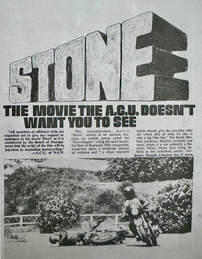
STONE - THE MOVIE THE A.C.U. DOESNT WANT YOU TO SEE.
"All members of affiliated clubs are requested not to give any support or assistance to the movie 'Stone' as it is considered by the Board of Management that the script of the film will be injurious to Australian motorcycling." A.C.U. of N.S.W.
"All members of affiliated clubs are requested not to give any support or assistance to the movie 'Stone' as it is considered by the Board of Management that the script of the film will be injurious to Australian motorcycling." A.C.U. of N.S.W.
The Australian made movie "Stone", shortly to be released, features an outlaw group called the "Gravediggers" riding the most beautiful fleet of Kawasaki 900s imaginable, numerous spills, a moderate amount of violence and "a chase sequence which should give the non bike rider the whole idea of what it's like to ride a big bike fast". Yet Sandy Harbutt, producer, director, co-writer and actor, claims it is not primarily a film about bikies; bikies here being defined as the unwashed, untidy "outlaw" one percent of motorcyclists. Whether Harbutt is justified in his claim or whether the A.C.U. is correct in believing that the film is merely a "glorification of the bikie" is an open question which can only be resolved by seeing the movie and even then the answer may well vary from person to person. Whatever your opinion, a film about an alternative life style and the people involved have bikes, which are an integral part of their lives. The film, while following its own story line, attempts to portray this way of life as truthfully as possible: (A Hell's Angel who read part of the script said "Hey man - that's me). Harbutt has been intimately involved with since he and Michael Robinson wrote it in October 1970. The film is thoroughly "trip", as anyone connected with it will tell you. A motorcyclist himself, he has been "into" bikes for about six years a currently owns a 750/ four. He intends to buy the ZI he used during the filming, as do several others of the crew. As far as bikes are concerned, he says "I am there forever." Most of the shooting was done in the last three months of last year at locations in and around Sydney, including Newcastle expressway, where hundreds of motorcyclists were used as extras in a funeral procession scene. Included were the Hell's Angels and Indian Pacific, and El Condors from Armidale. The "hearse" was Bob Levy's bored out Kawasaki kneeler outfit. Hornsby Police lent co-operation for this sequence, even to the extent of providing an escort and closing off a lane of the expressway while the riders got under way.
There were no problems, not even between the outlaws and the Law and everyone had a beautiful day. Another scene involved shooting at sunrise on a secluded beach which was accessible (in the dark) only by sea. So the Army was prevailed upon to provide a landing barge. After the shooting, the film crew was returned to nearby Balmoral beach where the vehicles were parked. Hundred of bathers, surprised to see a landing barge bearing down upon them, were completely stunned when the front dropped and a gaggle of "Grave Diggers" and their old ladies charged onto the beach in a fashion reminiscent of John Wayne at Iwo Jima and then throbbed off on their machinery. Much of the stunt riding was performed by Craig Brown and Brian Martin who, Harhutt says, "can lay rubber or pull wheelies anywhere you like" They also did some of the camera work. According to Martin, the fitting of the heavy camera does interesting things to a bike's handling characteristics, "I arrived at the first corner and thought I suddenly had two flat tyres." On another occasion, he was guiding the unwieldy rig around a corner at speed and came across a taxi, reversing around the corner. In spite of dodgy moments like these, the shooting went off without any incidents. Martin and everyone else we spoke to who had been directly involved in the making of the movie seemed filled with Harbutt's infectious enthusiasm for the production. He is easy to work with and the work was enjoyable although hard and often lasting long hours. In turn he was appreciative of the way people co-operated and made things easier for him, "everyone gave everything they had". Many were openly critical of the A.C.U. for passing judgement without having seen the film. Indeed the behaviour of the Board of Management would seem a little rash since it appears that, at most, only a few actually read the script and in any case it is very difficult to visualise a finished film from reading the script. "Stone" is the first full length film Harbutt has made, although he has been involved in television and theatre for many years. It is financed by the Film Development Corporation and Ross Wood Productions to the tune of $160,000. Harbutt was assisted by David Hannay, who has been working in film production for several years, music is by Billy Green, a talented, ex-Doug Parkinson musician. Whether "Stone" will be "injurious to Australian motorcycling" remains to be seen. Probably it will depend on the Australian audience to a large extent, whether that audience is mature enough to distinguish between the one percent and the remaining 99. "If Mr Holden driver and his wife leave the theatre without abetter understanding of the way of life , the picture will be that way a failure". We think he's being optimistic, but time and the movie will tell. In any case, if the film is one half as good as Harbutt believes, it will be well worth seeing. Cycle Australia March April 1974.
There were no problems, not even between the outlaws and the Law and everyone had a beautiful day. Another scene involved shooting at sunrise on a secluded beach which was accessible (in the dark) only by sea. So the Army was prevailed upon to provide a landing barge. After the shooting, the film crew was returned to nearby Balmoral beach where the vehicles were parked. Hundred of bathers, surprised to see a landing barge bearing down upon them, were completely stunned when the front dropped and a gaggle of "Grave Diggers" and their old ladies charged onto the beach in a fashion reminiscent of John Wayne at Iwo Jima and then throbbed off on their machinery. Much of the stunt riding was performed by Craig Brown and Brian Martin who, Harhutt says, "can lay rubber or pull wheelies anywhere you like" They also did some of the camera work. According to Martin, the fitting of the heavy camera does interesting things to a bike's handling characteristics, "I arrived at the first corner and thought I suddenly had two flat tyres." On another occasion, he was guiding the unwieldy rig around a corner at speed and came across a taxi, reversing around the corner. In spite of dodgy moments like these, the shooting went off without any incidents. Martin and everyone else we spoke to who had been directly involved in the making of the movie seemed filled with Harbutt's infectious enthusiasm for the production. He is easy to work with and the work was enjoyable although hard and often lasting long hours. In turn he was appreciative of the way people co-operated and made things easier for him, "everyone gave everything they had". Many were openly critical of the A.C.U. for passing judgement without having seen the film. Indeed the behaviour of the Board of Management would seem a little rash since it appears that, at most, only a few actually read the script and in any case it is very difficult to visualise a finished film from reading the script. "Stone" is the first full length film Harbutt has made, although he has been involved in television and theatre for many years. It is financed by the Film Development Corporation and Ross Wood Productions to the tune of $160,000. Harbutt was assisted by David Hannay, who has been working in film production for several years, music is by Billy Green, a talented, ex-Doug Parkinson musician. Whether "Stone" will be "injurious to Australian motorcycling" remains to be seen. Probably it will depend on the Australian audience to a large extent, whether that audience is mature enough to distinguish between the one percent and the remaining 99. "If Mr Holden driver and his wife leave the theatre without abetter understanding of the way of life , the picture will be that way a failure". We think he's being optimistic, but time and the movie will tell. In any case, if the film is one half as good as Harbutt believes, it will be well worth seeing. Cycle Australia March April 1974.
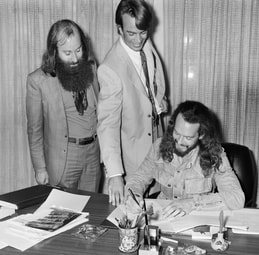
BEF To Distribute New Australian Film.
Rod Puskar, assistant to the general manager, BEF (Film Distributors) Australia Pty. Limited, has announced that the company will be distributing the Australian colour feature film, "Stone". "Stone" was co-written, produced and directed by Sydney actor Sandy Harbut and made through an investment by The Australian Film Development Corporation. Filmed on location in Sydney, "Stone" tells the story of an undercover policeman who is sent to investigate a series of murders following a political assassination. The murder victims are members of an outlaw bike gang, and during the course of his investigations the policeman rides with the gang and gets a fascinating insight into their unconventional life style. Ken Shorter plays the title role of Stone and other major stars of the production include Helen Morse, Hugh Keays-Byrne, Sandy Hurbutt, Rebecca Gilling, Vincent Gil and Bindi Williams. "Stone" is regarded as a breakthrough in the Australian film industry and its qualities are unique that it defies comparison with any other feature , either local or international. Billy Green, Melbourne composer-guitarist, has written for the film the most exciting and original music score ever produced in Australia. It will be issued as an album to coincide with the release of the film. Two vocal tracks, sung by Doug Parkinson, will be released as singles. Sandy Harbutt said: "I am delighted that BEF have decided to take 'Stone' into distribution, as I have received tremendous encouragement from the BEF team right from its inception and this can only benefit the film overall launching" The Australasian Cinema Thursday 30th May 1974.
Stone the movie was years ahead of its time and could be suggested that it was the first feature film about the disastrous experiences faced by Vietnam Veterans. Stone has all the essential ingredients of every successful film; beautiful women, heroic men, plenty of action, motorbikes, scenic views of Sydney, depth and meaning. In the movie Stone all the Grave Diggers are ex-serving members of the Australian Defence Force, mainly Vietnam; however, some from the Korean War. Stone was the life's work of Sandy who co-wrote, produced, directed, acted and wrote some of the lyrics for the music.
Sandy Harbutt 'What I decided to do, was actually form a motorcycle club and shoot the picture as a club'... before the commencement of filming the Hells Angels read the screen play and gave it their approval.
The script was written in 1970. It took two years before a backer stepped in - the Australian Film Development Corporation (federal government body which loans money to selected film makers). The script took two and a half weeks to write. The shooting schedule went for six weeks, working ten hours a day, six days a week. Most of the shooting was done in the last three months of the year. 'I wanted to shoot it as soon as possible and with as much sunlight as possible' stated Sandy. First week of filming all singular moments were shot i.e. assassin collecting his men, Mafia stuff, Police HQ and Stones place. For the next three weeks all the shots that involved bikes, Forth & Clyde Hotel, Middle Head and some street riding. In the last week it was all action i.e. double riding, explosions, deaths etc. An extra week was allocated to pick up bits and pieces as needed, with twelve weeks of editing and eight weeks of sound editing. Film locations were mainly in Sydney, including: North Sydney, Balmain, Washaway Beach, Middle Head, Lurline Bay Cliffs, Gosford Expressway and between Dubbo and Nyngan, about 580km west of Sydney for the final scene. During the filming, production attracted the attention of the Board of Management of the Auto Cycle Union of NSW, which requested affiliated clubs not to support the film due to it being 'injurious to Australian motorcycling'. NSW Police gave their support to the project after NSW Police public relations division approved the script. Sandy stated 'I don't see how the Auto Cycle Union is in any position to discuss the merits of a film script, what do they know about assessing scripts, have they ever seen a script?' Sandy also claimed that 'the Auto Cycle Union not only issued members with a circular putting down the film, they also wrote a letter to the NSW Police asking them to cease cooperation with the production'. During production Stone earned the dubious distinction of being the first movie ever to be condemned by the Auto Cycle Union of NSW... the Union, concerned at the films preoccupation with motorcycle gangs.
Revs Motorcycle News Columnist Chris Froebel described the film as 'cashing in' on the phenomenal success of the American feature ' On Any Given Sunday' and that 'there is no way that Mr Average public and his wife and kids are going to distinguish the members of an Auto Cycle Union affiliated club on a club run from a pack of bikies such as the fictional Grave Diggers of Stone fame, and that is very sad... Mr Average sees the bike, the man and the drab clothing, instant horror!', further suggesting that they expected 'Mr Harbutt to add 10 or 15 minutes of the film to explain that there is a difference'. So much was the disapproval of the article from Heron Productions, that Sandy Harbutt visited the office of the publication a week prior to the release of Stone into theatres. Sandy stated that 'Stone was not cashing in on anything'.
Sandy Harbutt 'What I decided to do, was actually form a motorcycle club and shoot the picture as a club'... before the commencement of filming the Hells Angels read the screen play and gave it their approval.
The script was written in 1970. It took two years before a backer stepped in - the Australian Film Development Corporation (federal government body which loans money to selected film makers). The script took two and a half weeks to write. The shooting schedule went for six weeks, working ten hours a day, six days a week. Most of the shooting was done in the last three months of the year. 'I wanted to shoot it as soon as possible and with as much sunlight as possible' stated Sandy. First week of filming all singular moments were shot i.e. assassin collecting his men, Mafia stuff, Police HQ and Stones place. For the next three weeks all the shots that involved bikes, Forth & Clyde Hotel, Middle Head and some street riding. In the last week it was all action i.e. double riding, explosions, deaths etc. An extra week was allocated to pick up bits and pieces as needed, with twelve weeks of editing and eight weeks of sound editing. Film locations were mainly in Sydney, including: North Sydney, Balmain, Washaway Beach, Middle Head, Lurline Bay Cliffs, Gosford Expressway and between Dubbo and Nyngan, about 580km west of Sydney for the final scene. During the filming, production attracted the attention of the Board of Management of the Auto Cycle Union of NSW, which requested affiliated clubs not to support the film due to it being 'injurious to Australian motorcycling'. NSW Police gave their support to the project after NSW Police public relations division approved the script. Sandy stated 'I don't see how the Auto Cycle Union is in any position to discuss the merits of a film script, what do they know about assessing scripts, have they ever seen a script?' Sandy also claimed that 'the Auto Cycle Union not only issued members with a circular putting down the film, they also wrote a letter to the NSW Police asking them to cease cooperation with the production'. During production Stone earned the dubious distinction of being the first movie ever to be condemned by the Auto Cycle Union of NSW... the Union, concerned at the films preoccupation with motorcycle gangs.
Revs Motorcycle News Columnist Chris Froebel described the film as 'cashing in' on the phenomenal success of the American feature ' On Any Given Sunday' and that 'there is no way that Mr Average public and his wife and kids are going to distinguish the members of an Auto Cycle Union affiliated club on a club run from a pack of bikies such as the fictional Grave Diggers of Stone fame, and that is very sad... Mr Average sees the bike, the man and the drab clothing, instant horror!', further suggesting that they expected 'Mr Harbutt to add 10 or 15 minutes of the film to explain that there is a difference'. So much was the disapproval of the article from Heron Productions, that Sandy Harbutt visited the office of the publication a week prior to the release of Stone into theatres. Sandy stated that 'Stone was not cashing in on anything'.
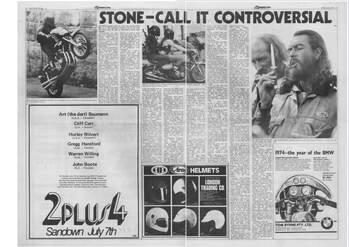
Rev Motorcycle News 05th-18th July 1974.
TV WEEK Magazine - Kens Back To Make A Shocker.
AUSTRALIAN actor Ken Shorter will fly home from London soon to star in a full length colour feature film which evolves around sex, dope and rock 'n' roll. The film, titled Stone, is being produced by fellow Australian actor/ writer Sandy Harbutt, who is confident that it will be the most eye opening film ever made in Australia. "One of our main aims is to shorten the generation gap by graphically portraying. the youth counter culture. Sandy said. "We are hoping the film will communicate rather than shock the audience." The Australian Film Development Corporation has offered to invest $63,000 in Stone, which is also being backed by Fontana Films to the tune of $20,000. Ken Shorter is to play the role of an off beat, longhaired hippie cop, whose assignment is to track down a political assassin. Ken has been in London for the past six months with his actress girl friend Darlene Johnson. They are expected to return to Australia before the end of February, in time for preliminary production of the film. The script was written by Sandy Harbutt in partnership with copywriter Michael Robinson, who has also written several film features for American Network television. Sandy is best known to Australian audiences as an actor with lead roles in many television productions, including a starring role in the television series The Long Arm. He has also worked extensively as a director, most recently directing and writing a documentary on the rock opera Jesus Christ Superstar for the Nine Network. Sandy spoke with TV WEEK shortly after announcing his plans for the film. "Michael Robinson and I first wrote the screenplay for Stone two years ago" he said, "but the concept must have been a few years ahead of its time, because we had troubles getting it off the ground. It's not easy to describe the film, but basically it involves the youth counter culture". Ken Shorter's role in Stone is vastly different from any previous portrayal of a cop. He is insolent to his superiors, sleeps with his girlfriend and rides a bike. But he is indispensable to the force because of his ability to mix with the younger generation. Ken Shorter is perfect for the part and he is one of Australia's most talented and experienced actors. Sandy and Michael spent months researching and gathering background information on the youth culture before writing the screen play. Although many scenes in the film are detailed and explicit, they feel it is justified in the cause of authenticity. "Too many youth films today try and water down the truth" Sandy said. "We feel there is no point in even starting the venture unless we can honestly show what's really happening." TV Week Magazine, 27th January 1973.
Tension was placed on the actresses playing the bikie molls. Sandy stated 'it took a lot of courage for those girls to handle the circumstances they were put in. They knew what they were getting into. I told them it was going to be dangerous. For a start, you'll be riding around on the back of motorcycles which is innately dangerous and we will be dealing with some dangerous people, some of the girls said that's terrific'. The dangerous people were some of the members of the local motorcycle clubs at the time.... 'they turned up at the studio a couple of weeks before we started shooting. I still don't know how they found out what was going on, but they came to the desk and said we would like to meet the bloke that's making this movie, there was four of them, we had a talk and got along pretty well'.
The period of engagement for actors was between Monday 22nd October-Saturday 08 December 1973 at the sum of $110.00 per week, being for a 6 day, 60 hour week; however, contracts generally varied depending on the actors role in the film. Various actors worked on the film for 'free' pre-production and post production; Helen Morse and Margaret Ure worked before filming commenced, preparing all the cuts-offs, with John 'Zonk' stating 'the real work commenced when the film was released'.
Most of the parts were written for particular actors, except for Stone. All of them were people Sandy had worked with and generally they weren't fantastically successful. They were always doing unusual parts on Homicide or small theatrical roles; however, Sandy and Helen had always known them and knew how fantastic they were.
A member of the Grave Diggers 'Toad', played by English theatre actor Hugh Keays-Bryne actually attended Sandy's audition by accident, accompanying another actor to the test while he was on downtime visiting Australia playing the part of a lion in the RSC production 'Midsummers Nights Dream'. He hired him on the spot.
Most of the locations were written for the script and the ones that weren't were difficult to find. They accidentally discovered some of the locations, like the beach between Balmoral and the Harbour, where the dawn swim scene was filmed. David Hannay found the location for Stones house at the last moment at Whale Beach as Sandy couldn't find a location that worked for Stones place. At first Sandy thought Stone would be suited to an arty pad at Paddington; however, Sandy could not find a suitable location in that area. The money was not available to design a set and the movie didn't have a designer.... then Sandy thought 'we will make him a surfer and put him up at Whale Beach'... suddenly opening the character out into being that whole hedonistic nature trip - Mr Natural.
Other locations were hamburgers joints, Davy's Gym and the pool hall at Bondi Junction. The Police Station was Commonwealth Police. The Mafia meeting was shot at United Sounds dudding suite.
The period of engagement for actors was between Monday 22nd October-Saturday 08 December 1973 at the sum of $110.00 per week, being for a 6 day, 60 hour week; however, contracts generally varied depending on the actors role in the film. Various actors worked on the film for 'free' pre-production and post production; Helen Morse and Margaret Ure worked before filming commenced, preparing all the cuts-offs, with John 'Zonk' stating 'the real work commenced when the film was released'.
Most of the parts were written for particular actors, except for Stone. All of them were people Sandy had worked with and generally they weren't fantastically successful. They were always doing unusual parts on Homicide or small theatrical roles; however, Sandy and Helen had always known them and knew how fantastic they were.
A member of the Grave Diggers 'Toad', played by English theatre actor Hugh Keays-Bryne actually attended Sandy's audition by accident, accompanying another actor to the test while he was on downtime visiting Australia playing the part of a lion in the RSC production 'Midsummers Nights Dream'. He hired him on the spot.
Most of the locations were written for the script and the ones that weren't were difficult to find. They accidentally discovered some of the locations, like the beach between Balmoral and the Harbour, where the dawn swim scene was filmed. David Hannay found the location for Stones house at the last moment at Whale Beach as Sandy couldn't find a location that worked for Stones place. At first Sandy thought Stone would be suited to an arty pad at Paddington; however, Sandy could not find a suitable location in that area. The money was not available to design a set and the movie didn't have a designer.... then Sandy thought 'we will make him a surfer and put him up at Whale Beach'... suddenly opening the character out into being that whole hedonistic nature trip - Mr Natural.
Other locations were hamburgers joints, Davy's Gym and the pool hall at Bondi Junction. The Police Station was Commonwealth Police. The Mafia meeting was shot at United Sounds dudding suite.
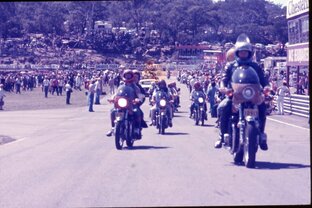
The Castrol Six Hour Motorcycle Race, Sunday 13th October 1973 at Amaroo Park, Sydney, where the Grave Diggers completed a lap of the circuit prior to the commencement of the race on their Z1 Kawasaki 900's in front of 16,000 spectators as part of a promotional tour.
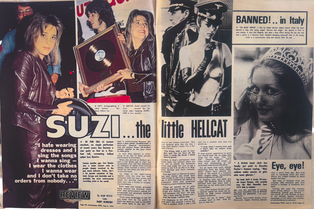
SUZI... the little HELLCAT.
Suzi autographs a bikie helmet...the boys follow her...
Suzi autographs a bikie helmet...the boys follow her...
Suzi is controversial because she plays a bass guitar (traditionally a men-only musical instrument) and she always wears all-leather outfits, similar to the gear worn by bikie girls. In fact, Suzi Quatro is something of an idol to bikie groups, particularly in Australia. When she arrived at Sydney airport a few weeks ago to start her Australian tour she was welcomed by platoons of bikies from several gangs. They formed a motor cycle escort for her when she was driven to her city hotel. On stage in her tight-fitting leather suits she rubs her body erotically with her bass guitar and sends her devoted male and female fans into a frenzy of screaming excitement. Both male and female groupies hang around her dressing room after each performance asking for autographs and generally wanting to get to know her. Australian Post June 1974.
Suzi Quatro was welcomed to Sydney Airport on Sunday 05th May 1974 by 20 members of the Hells Angels and Grave Diggers. Both clubs provided an escort to her hotel in Kings Cross. Suzi Quatro was in Sydney to perform at the Hordern Pavilion, Moore Park on Tuesday 07th May 1974, with the Sunday Telegraph stating 'A bunch of bikies took over pop star Suzi Quatro's press conference when she arrived in Sydney yesterday. In full bikie leather gear and complete with tattoos, knives and boots, they clowned in front of the TV cameras, microphones and notebooks. One drank from a wine skin during the interviews and belched loudly.... Suzi looked like a bit of a biker herself, only neater and cleaner. The bikies accorded Suzi the honour of their presence and a 20 strong motorcycle escort to her hotel because she is a rock n roll singer and bikies like rock n roll.
Intertwined between the BlackHawks and Grave Diggers was a mix of actors and real life bikers and Ol ladies. Stone comes from the wild outlaw days of Australian filmmaking where extras were paid in marijuana and cases of beer and where cast were required to double up to support film crew positions. Stone was made on a restricted budget of $192,000, with many of the cast working in various behind the scene jobs… Sandy ‘Undertaker’ Harbutt,wrote the script, directed, produced, acted and scribed some of the music for the film Stone, Ken 'Stone' Shorter made leather items for the film, Billy '69' Green acted, wrote and sung the music for the film, Vince 'Dr Death'Gill acted and worked as a grip throughout the film, Helen ‘Amanda’ Morse acted and was costume design, Margaret ‘Jay’' Ure acted and was costume design, Vince Tesseriro rode the coffin side car in the funeral scene and was in charge of marketing, Michael 'Pinball' Robinson co-wrote the screenplay and Dave Hart painted all the 16 Z1 Kawasaki 900's and was a supporting artist as a background extra. Actors were given a small clothing budget to improvise in accordance with their interpretation of their character; however, most were required to wear their own items due to budget constraints. All back patches and embellishments on front of the Grave Diggers cut-offs were sown on by hand by Helen Morse and Margaret Ure. 'Our Job was finding out which floor they left their cloths on' Helen Morse.
The Forth and Clyde Hotel had been a famous bikie pub for at least 10 years. Every Thursday night there would be at lease 150 bikes. It took Sandy a considerable amount of time to locate the owner because the realestate agents were selling the pub to themselves through various dodges, which made them fantastically paranoid. The real estates did not want Sandy to get involved; however, Sandy located the person who was purchasing the pub and he said 'it was available for filming'. The realestate agents gave Sandy a lot of trouble and tired to cancel to shoot the day before Stone started filming in the pub. Tooths redesigned to interior of the pub to suit the filming. Money was spent on putting glass back into the windows... the interior was run down and suited the scenes, so nothing was changed.. and all the old posters were placed back in also.
During the scene before the cross and bow is fired into the pinball machine, seven takes were required and Karyn 'Sunk' Love made sure temple hash was available for cast during takes… 'after seven takes we were feeling quite relaxed'.
In Stone, Rebecca Gilling played a bikie moll, frolicking on the beach nude and smoking pot... 'there was a bit of hallucinating going on as well, probably'; however, we weren't stoned all the time, there was a degree of discipline about what we were doing... there was a sense of you didn't get stoned until after'.
The scene in the fort, where the Grave Diggers are smoking dope took 25 hours to film.
The females in Stone were a collection of a couple of camps… models or actors who were represented by Hedon Productions and those without any acting credentials that were part of the 'biker life and culture'. Margaret ‘Jay’ Ure lived up the street from Sandy 'Undertaker' Harbutt and knew Dewey 'Septic' Hungerford. During the development of the script Margaret asked Sandy ’am I in it', Sandy stated 'of course you are Margi’. Margaret stated that ‘It never felt like a job as most of us were friends… we lived it’.
The Forth and Clyde Hotel had been a famous bikie pub for at least 10 years. Every Thursday night there would be at lease 150 bikes. It took Sandy a considerable amount of time to locate the owner because the realestate agents were selling the pub to themselves through various dodges, which made them fantastically paranoid. The real estates did not want Sandy to get involved; however, Sandy located the person who was purchasing the pub and he said 'it was available for filming'. The realestate agents gave Sandy a lot of trouble and tired to cancel to shoot the day before Stone started filming in the pub. Tooths redesigned to interior of the pub to suit the filming. Money was spent on putting glass back into the windows... the interior was run down and suited the scenes, so nothing was changed.. and all the old posters were placed back in also.
During the scene before the cross and bow is fired into the pinball machine, seven takes were required and Karyn 'Sunk' Love made sure temple hash was available for cast during takes… 'after seven takes we were feeling quite relaxed'.
In Stone, Rebecca Gilling played a bikie moll, frolicking on the beach nude and smoking pot... 'there was a bit of hallucinating going on as well, probably'; however, we weren't stoned all the time, there was a degree of discipline about what we were doing... there was a sense of you didn't get stoned until after'.
The scene in the fort, where the Grave Diggers are smoking dope took 25 hours to film.
The females in Stone were a collection of a couple of camps… models or actors who were represented by Hedon Productions and those without any acting credentials that were part of the 'biker life and culture'. Margaret ‘Jay’ Ure lived up the street from Sandy 'Undertaker' Harbutt and knew Dewey 'Septic' Hungerford. During the development of the script Margaret asked Sandy ’am I in it', Sandy stated 'of course you are Margi’. Margaret stated that ‘It never felt like a job as most of us were friends… we lived it’.
Victoria Anoux plays Flossie, a girl who has an uncontrollable urge to remove her clothes. A game of strip-jack poker in the film provides a golden opportunity for Flossie — especially as she keeps losing!
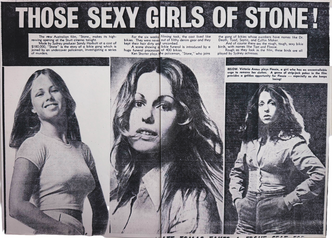
The new Australian film, "Stone,, makes its high revving opening at the Sturt cinema tonight. Made by Sydney producer Sandy Harbutt at a cost of $180,000, "Stone" is the story of a bikie gang which is joined by an undercover policeman, investigating a series of murders. For the six weeks filming took, the cast lived like bikies. They were never out of filthy denim gear and they kept their hair dirty and uncombed. A scene showing a bikie funeral is introduced by a huge funeral procession of 400 bikies, whose members have names like Dr Death, Toad, Septic, and Coffin Maker. Of course there are the rough, tough, sexy bikie birds, with names like Tart and Flossie. Rough as they look in the film, these birds are all played by Sydney actresses.
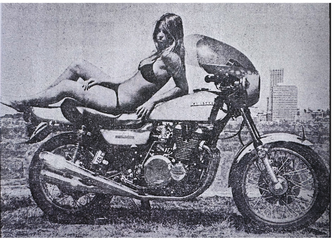
Two reasons why the soon to be released movie Stone will be a smash hit are the big bikes and pretty girls. One of those roles is filled by Julie Edwards and the other by a Kawasaki Z1, seen here fitted with a bikini pairing and custom paint job.
WILLOWY red-haired Jude Matthews has switched from modelling to acting and her new career has launched in Sandy Harbutt's feature film Stone. Jude plays the role of a bikie's moll in Stone and spent six weeks filming on location in Sydney with 15 other actors and actresses who were playing the bikie group, The Gravediggers. Before Stone, Jude spent several years in photographic and commercial modelling, appearing in many of the advertisements seen nationally on television. She's quite happy to make her career in Australia having spent several years travelling the world. At one stage she worked for six months with Gene Kelly in Hollywood. Jude feels Australia is the place to be now.
WILLOWY red-haired Jude Matthews has switched from modelling to acting and her new career has launched in Sandy Harbutt's feature film Stone. Jude plays the role of a bikie's moll in Stone and spent six weeks filming on location in Sydney with 15 other actors and actresses who were playing the bikie group, The Gravediggers. Before Stone, Jude spent several years in photographic and commercial modelling, appearing in many of the advertisements seen nationally on television. She's quite happy to make her career in Australia having spent several years travelling the world. At one stage she worked for six months with Gene Kelly in Hollywood. Jude feels Australia is the place to be now.
Trinket Time Is Back For Rebecca.
ACTRESS Rebecca Gilling wants to try TV acting so she's all-out to grab attention... Rebecca has been acting since she left school in Sydney two years ago. She has been seen on TV in lots of commercials but she's best known for a series of hair shampoo ads.Her first straight acting role was in the film Stone, which was followed by a large part in the Number 96 feature film. Rebecca is keen to try stage and TV acting and is determined to be properly prepared. She's been through two acting courses and is now on her third, five mornings a week, studying both the spiritual and technical side of acting. TV Times May 1974.
I Want To Keep My Clothes On.
SYDNEY actress Rebecca Gilling doesn't give two hoots about appearing nude before a movie camera. But just for a change she'd like to keep her clothes on throughout her next film assignment. Rebecca appeared nude in two scenes in the Sandy Harbutt movie "Stone" and she was naked in three scenes in the yet-to-be-re-leased "Number 96" movie, based on the controversial TV serial. "So I've made only two movies and I've been required to bare my body in both of them," 20-year-old Rebecca told POST. "And before I worked in those two films I was standing up nude as an artists' model at the East Sydney Tech. "It's just been one nude job after another and, quite frankly, I'm a little concerned that this situation could be detrimental to my career." Rebecca explained that personally she couldn't care less about the nude scene requirements of her two movies, but she's worried that she might be stuck with these kind of parts and miss opportunities to show her acting capabilities. "I don't want to be regarded as just a nice body and a pretty face," she said. "I believe I have a brain and some talent, so don't want to rely on whatever good looks I have for my future career. "T'd like to stress again that I have nothing whatever against nudity in a movie, but if I'm to get anywhere as an actress I'm going to need acting roles. I don't want to be put into a cast just because of my shape." As it happens Rebecca's role in the "Number 96" movie gives her the chance to show off both her acting abilities and her body. She portrays the air hostess girlfriend of regular "96" character Jack Sellars, played by Tom Oliver. In the movie she lives in a flat in the Number 96 apartment building and begins a torrid affair with Sellars, Script requirements call for her to be seen nude in bed, in a shower and naked as she flirts across the lounge, Australian Post March 1974.
Toad' and 'Dewey' wore a Sheriff's Badge, 'Undertaker' wore a Police Badge and 'Zonk' wore a Police Boys Club pin. The Grave Diggers wore badges and emblems associated with the constabulary on their cut-offs to indicate their standing against civil authority of government. 'Stone' ,'Dr Death' and 'Stinkfinger' wore the Rolling Stones Tongue. The Rolling Stones 'tongue and lips' logo was designed by John Pasche in 1970. The logo was inspired by the Hindu goddess Kali, who is often depicted with her tongue sticking out. The logo was intended to be a protest symbol that represented the band's anti-authoritarian attitude.
To the surprise of the contemporary arts society, Sandy Harbutt received some government funding for his film, but in retrospect, it appears the Australian Film Commission (AFC) had no real idea what type of film Stone was and rather than sell the rights to the film up front to the AFC , Sandy Harbutt and David Hannay opted instead to trim their original budget from $650,000 to $192,000.
Distribution of earnings - Australian Film Commission 50%, Ross Wood Productions 19% and Hedon Productions 31%. Hedon Productions distribution was further shared to - Peter Armstrong, Ken Shorter, David Hannay, Ian Barry, Paul Landa, Billy Green, Michael Robinson, with Hedon Productions receiving 9% from the initial 31%.
To the surprise of the contemporary arts society, Sandy Harbutt received some government funding for his film, but in retrospect, it appears the Australian Film Commission (AFC) had no real idea what type of film Stone was and rather than sell the rights to the film up front to the AFC , Sandy Harbutt and David Hannay opted instead to trim their original budget from $650,000 to $192,000.
Distribution of earnings - Australian Film Commission 50%, Ross Wood Productions 19% and Hedon Productions 31%. Hedon Productions distribution was further shared to - Peter Armstrong, Ken Shorter, David Hannay, Ian Barry, Paul Landa, Billy Green, Michael Robinson, with Hedon Productions receiving 9% from the initial 31%.
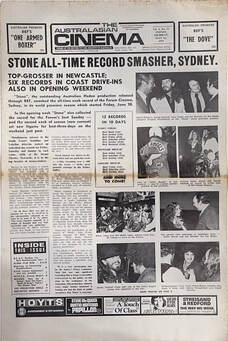
The Australasian Cinema.
Forum Of The Motion Picture Industry Of Australia.
Thursday 11th July 1974.
Top Grosser In Newcastle.
Six Records In Coast Drive Ins... also Opening Weekend.
Forum Of The Motion Picture Industry Of Australia.
Thursday 11th July 1974.
Top Grosser In Newcastle.
Six Records In Coast Drive Ins... also Opening Weekend.
"Stone", the outstanding Australian Hedon production released through BEF, smashed the all-time week record of the Forum Cinema, Sydney, in its world premiere season which started Friday, June 28. In the opening week "Stone" also collected the record for the Forum's best Sunday and the second week of season (now current) set new figures for best three days on the weekend just past"
Success in any business is usually preceded by a lot of hard work and "Stone" was launched with a tremendous promotional campaign. The full forces of both Hedon, the producing company, and BEF, as distributors, were combined for the attack, in conjunction with the promotional and theatre division of The Greater Union Organisation. Sandy Harbutt, writer/ producer/ director of "Stone" was extremely enthusiastic in an exclusive interview with Cinema. "The launching of "Stone" was a perfect combination of BEF'S merchandising expertise and our own knowledge of the media and the potential audience," he said.
A special television commentary on the filming of "Stone", produced by Brian Trenchard-Smith, played 8.30 p.m. prime time on Channel 9 to an enormous viewers' audience, heralded by a full week of extensive studio promotion.
Sandy Harbutt, writer/ producer/ director of "Stone" was extremely enthusiastic in an exclusive interview with Cinema. "The launching of 'Stone" was a perfect combination of BEF'S merchandising expertise and our own knowledge of the media and the potential audience" he said.Media response to invitations to attend the world premiere preview on Thursday (27) was incredible - almost 100 per cent acceptances.
Everyone in media (including the Minister for the Media, Senator Douglas McClelland) was there to mingle with the stars and the genuine
"Hell's Angel's" bikie gang (who assisted greatly in the production) zoomed up to the Forum in full riding gear. Their bikes filled the entire frontage of the Forum and its adjoining sweets/drinks shop, the area having been specially reserved for them by the N.S.W. Police.
Expressing his gratification at the success of "Stone", John Fraser, general manager of BEF, told Cinema: "When Sandy Harbutt approached me in London some three years ago with his idea for this film, I was intrigued by its commercial possibilities". On behalf of BEF, I want to say "how tremendously thrilled we are at being so closely involved in the public presentation and marketing of what has proven a splendidly commercial product".
Great interest was shown in the stunt riders and one particular event - a bike screaming over a cliff into the ocean - broke great pictorial coverage in the Sydney dailies.
Success in any business is usually preceded by a lot of hard work and "Stone" was launched with a tremendous promotional campaign. The full forces of both Hedon, the producing company, and BEF, as distributors, were combined for the attack, in conjunction with the promotional and theatre division of The Greater Union Organisation. Sandy Harbutt, writer/ producer/ director of "Stone" was extremely enthusiastic in an exclusive interview with Cinema. "The launching of "Stone" was a perfect combination of BEF'S merchandising expertise and our own knowledge of the media and the potential audience," he said.
A special television commentary on the filming of "Stone", produced by Brian Trenchard-Smith, played 8.30 p.m. prime time on Channel 9 to an enormous viewers' audience, heralded by a full week of extensive studio promotion.
Sandy Harbutt, writer/ producer/ director of "Stone" was extremely enthusiastic in an exclusive interview with Cinema. "The launching of 'Stone" was a perfect combination of BEF'S merchandising expertise and our own knowledge of the media and the potential audience" he said.Media response to invitations to attend the world premiere preview on Thursday (27) was incredible - almost 100 per cent acceptances.
Everyone in media (including the Minister for the Media, Senator Douglas McClelland) was there to mingle with the stars and the genuine
"Hell's Angel's" bikie gang (who assisted greatly in the production) zoomed up to the Forum in full riding gear. Their bikes filled the entire frontage of the Forum and its adjoining sweets/drinks shop, the area having been specially reserved for them by the N.S.W. Police.
Expressing his gratification at the success of "Stone", John Fraser, general manager of BEF, told Cinema: "When Sandy Harbutt approached me in London some three years ago with his idea for this film, I was intrigued by its commercial possibilities". On behalf of BEF, I want to say "how tremendously thrilled we are at being so closely involved in the public presentation and marketing of what has proven a splendidly commercial product".
Great interest was shown in the stunt riders and one particular event - a bike screaming over a cliff into the ocean - broke great pictorial coverage in the Sydney dailies.
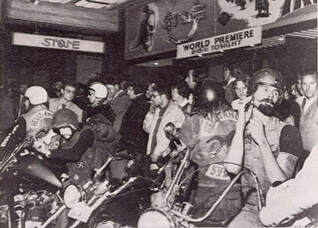
Bikes, bikes and still MORE bikes, extended more than 50 metres in front of the Forum.
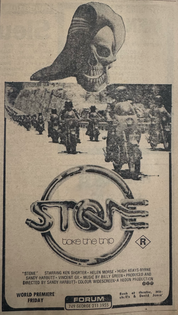
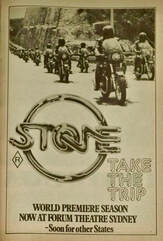
Sunday Telegraph Newspaper World Premiere Advertisement 1974.
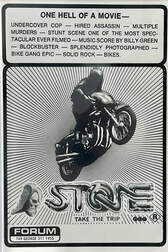
Stone Promotional Material 1974.
|
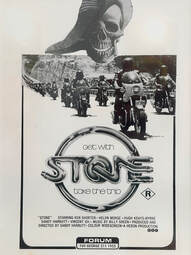
Stone Promotional Material 1974.
Images displayed are vintage template newspaper cinema advertisements for Stone. These advertisements were used in newspapers to promote the movie screening with timings displayed within the bottom corners. |
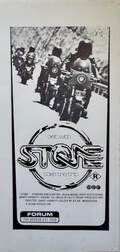
Stone Promotional Material 1974.
|
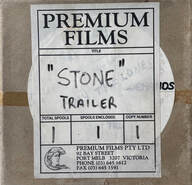
When Stone originally hit theatres in 1974, it featured a theatrical cut that director Sandy Harbutt felt was severely bloated and poorly paced. This Premium Films trailer belongs to the later "Directors Approved Cut" re-release campaign handled by the distributor. While the film was originally distributed theatrically in 1974 by British Empire Films, Premium Films took over the rights in the mid 1990s and managed the 1995 theatrical re-release of Stone in Australia.
The primary purpose of the re-release trailer was to announce a brand new director's cut completely re-edited by Sandy Harbutt, who stripped out roughly 34 minutes of footage to tighten action scenes, alter music cues and lean heavily into the raw biker lifestyle drama. This marketing campaign marked a massive shift in tone from the 1974 original trailer, which had marketed the film as a psychedelic, counterculture journey using the iconic tagline "Take the trip." In stark contrast, the new trailer re-framed the movie as a hard hitting, legendary grandfather of "Ozploitation" cinema. Instead of trying to sell a weird hippie flick, the modern trailer targeted pure nostalgia, celebrating the Gravediggers motorcycle gang as an essential piece of Australian pop culture history that was now officially "Director Approved" for fans who grew up on the original theatrical cut.
The primary purpose of the re-release trailer was to announce a brand new director's cut completely re-edited by Sandy Harbutt, who stripped out roughly 34 minutes of footage to tighten action scenes, alter music cues and lean heavily into the raw biker lifestyle drama. This marketing campaign marked a massive shift in tone from the 1974 original trailer, which had marketed the film as a psychedelic, counterculture journey using the iconic tagline "Take the trip." In stark contrast, the new trailer re-framed the movie as a hard hitting, legendary grandfather of "Ozploitation" cinema. Instead of trying to sell a weird hippie flick, the modern trailer targeted pure nostalgia, celebrating the Gravediggers motorcycle gang as an essential piece of Australian pop culture history that was now officially "Director Approved" for fans who grew up on the original theatrical cut.
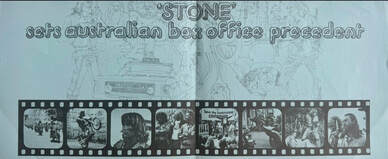
'Stone Sets Australian Box Office Precedent' Gatefold Advertising Brochure. Design artwork by Peter Ledger 1974.
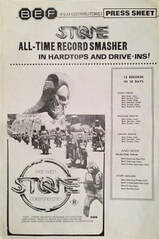
Press Sheet 1974.
|
Two Wheels Magazine
Advertisement 1974. |
Cleo Film Preview - Stone.
BRACE YOURSELF for the latest offering from the Australian film industry - an action-packed thriller aimed straight at the box office. It's called Stone and it takes a hard, close look at the lifestyle of a bikie gang. The film stars Ken Shorter as Stone, an undercover policeman; Helen Morse as his girlfriend, Amanda; Sandy Harbutt as the Undertaker, the leader of the Grave Diggers (the bikie gang), and a cast of characters who sound like a bizarre version of Damon Runyon. There is big Roger Ward playing. Hooks, the gang perv; Dewey Hunger-ford as Septic; James H. Bowles as Stinkfinger; Bindi Williams as Captain Midnight and John Ivkovitch as Zonk. The story opens in Sydney's Domain where a crowd gathers at an anti-pollu-tion political rally. The Grave Diggers ride into the scene, stoned, drunk and raving. Gang sergeant-at-arms Toad inadvertently witnesses the assassination of a national political figure, which triggers off an attempt to murder the Grave Diggers. Stone, an undercover cop, is assigned to ride with the bikies to uncover the mystery. Toad is played by Hugh Keays-Byrne, a British actor who stayed in Australia after a tour as a member of the Royal Shakespeare Company. Other cast members include Vincent Gil as Dr Death, the gang's spiritual leader whose creed is Satanism; Slim de Grey as Inspector Hannigan; Ray Bennett as Sergeant Larsen; and Owen Weingott as Alder from ASIO Stone was shot on location in Sydney, Gosford and Dubbo, NSW. The Sydney locations were selected for their spectacular views. Bike scenes were captured on the Gosford Expressway where 400 real bikies gathered for the funeral procession sequence Cast members in Stone got into their roles by living. as real bikies for the duration of the filming. Sandy Harbutt, the film's director, producer, writer and cast member, had the others join him in wearing filthy denims for six weeks and forgetting about bathing completely. The film's music, which was written by Melbourne composer and guitarist Billy Green, will be released shortly by Warner Brothers. Two vocals, Rage and Cosmic Flash, sung by Doug Parkinson, will be released as singles. Stone is to be released by BEF throughout Australia in July. Cleo Magazine July 1974.
The world premier was held at 8.15pm Thursday 27th June 1974 at Forum Theatre, George Street, Sydney with special guests to the opening being the Hells Angels, Gypsy Jokers, Black Hawks, Lone Wolf Motorcycle Club and Federal Minister of Media, Senator Douglas McClelleand. General release commenced on Friday 28th June 1974. Originally released by British Empire Films (BEF) with a name change to Greater Union (GUO), the film ran for 15 weeks in the Forum Theatre, Sydney. The BEF/ GUO contract expired on Tuesday 29th June 1979. The film was re-edited and re-submitted to the Australian Classification Board by Hedon Productions for release on Friday 01st November 1979. Hedon productions self distributed the film for a short period of time before handing over the rights to Eric Dare/ The House Of Dare in 1982 - 1984, releasing Stone in the 1980's under Garland Productions PTY, LTD, returning back to Hedon Productions on conclusion of the arrangement. The movie was released by Roadshow Entertainment on Betamax and VHS in 1985, Magna Pacific on VHS from 2001, Severin Films on DVD in 2008 and Umbrella Entertainment on Blu-Ray DVD in 2021.
BEF stated on Monday 20th August 1974 'Stone continues to live up to our expectations and the play off pattern is continuing to look excellent. Now that the revenue has started to come in on a regular basis, we look forward with the continuing success right through Australia and we are delighted as you are of its performance'. Stone was consistently earning $3000 - $5000 per month from the fifteen 35mm prints booked throughout Australia by December 1975 with 75% of the earnings taken from drive ins'.
BEF stated on Monday 20th August 1974 'Stone continues to live up to our expectations and the play off pattern is continuing to look excellent. Now that the revenue has started to come in on a regular basis, we look forward with the continuing success right through Australia and we are delighted as you are of its performance'. Stone was consistently earning $3000 - $5000 per month from the fifteen 35mm prints booked throughout Australia by December 1975 with 75% of the earnings taken from drive ins'.
Stuntman In Cliff Plunge.
SYDNEY stuntman Peter Armstrong supplied a few dramatic seconds for Sandy Harbutt's feature film, Stone, by riding a motorcycle at speed over a cliff at Maroubra south of Sydney. Stone, which stars Ken Shorter, tells of a member of a motorcyle club who was an accidental witness to an assassination and whose club colours were recognised by the assassins. One by one, his colleagues are killed. One of them is forced off the road by a car and ends up over the cliff in a scene done by Armstrong. A 450cc motorcycle was disguised to double for the bikie's 900cc machine for the stunt. The scene was filmed by four cameras. Armstrong rode his bike up a ramp on the cliff-top. He estimates he was travelling at 50km/h (30 mph) when he left the ramp and hurtled over the top of the 23m (76ft) cliff. He abandoned his bike to continue the rest of his plunge in free fall. He's not sure at what speed he hit the water, but the impact was sufficient to knock him unconscious. In the film, the rider will have disappeared without trace. Armstrong was more fortunate. Two skin-divers on a TV camera boat went to his rescue and hauled him into the launch where he was examined by a doctor. He was then taken to hospital for a complete examination, and was discharged after treatment for internal bruising. TV Times Saturday 23rd March 1974.
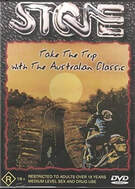
Hedon Productions 1998.
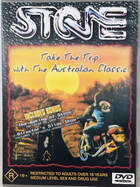
Magna Pacific. Released Tuesday 01st May 2001.
|
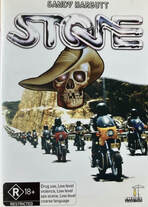
Umbrella Entertainment. Released Tuesday 01st September 2009.
|
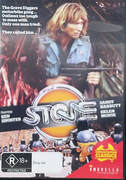
Umbrella Entertainment. Released Wednesday 07th April 2021.
|
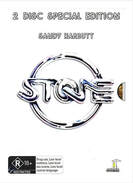
Unbrella Entertainment 2 Disc Special Edition. Released Wednesday 02nd April 2008.
|
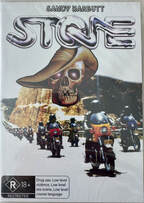
Hedon Productions. Released 2009.
|
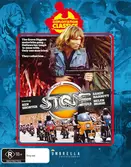
Umbrella Entertainment 2 Disc Limited Edition. Released Wednesday 07th April 2021 as part of the Ozploitation Classic Line.
Stone was scanned in 4K from the original 35mm interpositive, colour graded and cleaned up with dirt removal by Road Digital - Charlie Ellis. DVD slick designed by Simon Sherry. Simon Sherry is a Melbourne based illustrator who produced artwork for Umbrella Entertainment’s Blu Ray titles over a 7 year period. |

Stone Grade and Audio Preview Blu-Ray Disc. Umbrella Entertainment Wednesday 21st October 2020.
Vroom - Vroom Cinema.
NSW film maker Sandy Harbutt latches on to Sydney's bikie syndrome for his inaugural feature "Stone" (Sturt Cinema, restricted).
NSW film maker Sandy Harbutt latches on to Sydney's bikie syndrome for his inaugural feature "Stone" (Sturt Cinema, restricted).
But, having latched on to a contemporary social theme, he then gives it away. Lacking either a consistent point of view or characterisations any more than skin deep, "Stone" comes out as 132 minutes of vroom-vroom cinema about chaps on motorcycles. The leather jacket lads at yesterday's opening session liked it to end, indicating that "Stone" is a pretty good piece vroom-vroom. Its continuous formation riding gets its own gaudy splendor from Graham Lind's Eastmancolor camera-work, even if the riders look like fugitives from "Planet of the Apes." Harbutt's Gravedigger bikies are all healthy, young non taxpaying citizens. He holes them up in an old Army fort, with their "pot," resident satanist guru, indistinguishable molls and their jive talk, man. Here comes drug squad cop Stone (Ken Shorter), to find out who is killing off the Gravediggers. "It must be a radical left wing group. or a radical right wing group," sharply observed ASIO's man on the spot (Owen Weingott). "Stone" works well enough on its own level of entertainment, but a 20 minute cut might do wonders for it. For despite Harbutt's visually adventurous, try anything direction, "Stone" is slow, man, slow. Unless you dig bikies endlessly going around those endless Sydney bends. The Advertiser Saturday 20th July 1974.

Passion Playmates.
'Ken Shorter and Helen Morse in a torrid passion-pit scene from Stone'.
'Ken Shorter and Helen Morse in a torrid passion-pit scene from Stone'.
Yet another sexy - and sensational - Australian made movie is on the way and this one is called Stone and is certain to cause an uproar. In one major scene. a beach is turned into a passion pit for scores of bikies and their girls. The bikies frolic in the sea in the nude - and then comes an all- n sex orgy on the sands.
"The nude scenes will raise eyebrows wherever the film is shown." says Sandy Harhutt. the film's producer director. Sandy also plays the role of a bikie gang leader. The sex orgy scenes were shot all on an isolated Sydney beach. "We were dropped by a naval landing craft just before dawn." Sandy said. "At first everyone was a bit shy but soon they warmed up to things." Sunday Herald 1974.
"The nude scenes will raise eyebrows wherever the film is shown." says Sandy Harhutt. the film's producer director. Sandy also plays the role of a bikie gang leader. The sex orgy scenes were shot all on an isolated Sydney beach. "We were dropped by a naval landing craft just before dawn." Sandy said. "At first everyone was a bit shy but soon they warmed up to things." Sunday Herald 1974.
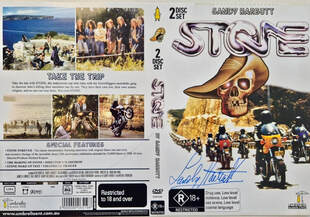
Sandy Harbutt signed DVD Slick 2008.
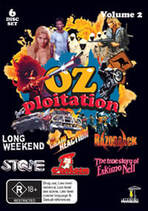
OZploitation Volume 2. Umbrella Entertainment Monday 03rd November 2008.
|
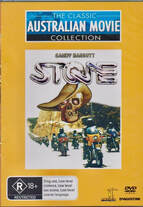
The Classic Australian Movie Collection. Umbrella Entertainment and DeAgostini Wednesday 16th July 2008.
The Classic Australian Movie Collection was a newsagency exclusive DVD and magazine series published fortnightly. |
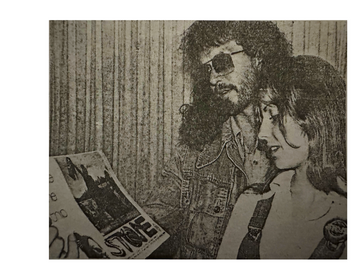
Movie With A Message.
Violence is not the way. In a nutshell that's the message behind Australia's all time record smashing movie "STONE." But the man who gave movie its message, Sandy Harbutt, still believes that if you want to show the futility of violence, you've got to show violence. Sandy, who wrote, produced, directed, designed and acted in "Stone" was in Townsville yesterday with the leading lady Helen Morse, to promote a midnight preview of the film last night. The film is all Australian made and was largely assisted by the Federal Government's Film Development Corporation. "STONE" carries an "R" certificate, but that is currently under review. Sandy feels the "R" rating is depriving the age group which would stand to gain the most from seeing the movie. Helen, who plays Stone's girlfriend in the film, says the reason for the movie's success was that it was made by people who understood the subject. "Everybody had an important part to play," she said. The movie was produced on a budget of $190,000 and shot throughout October and November of last year. Plans are already underway to have film launched in the United Kingdom and later in the United States. "STONE" opens its Townsville season next Friday night. Sandy Harbutt and leading lady Helen Morse, pictured in Townsville yesterday.
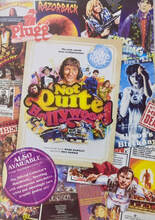
Not Quite Hollywood.
The Wild Untold Story Of Ozploitation.
City Films Worldwide 2008.
Ozploitation - A genre of Australian low budget produced films popular from 1970 to the mid 1980's. The term was popularized by Mark Hartley in the 2008 documentary Not Quite Hollywood.
The Wild Untold Story Of Ozploitation.
City Films Worldwide 2008.
Ozploitation - A genre of Australian low budget produced films popular from 1970 to the mid 1980's. The term was popularized by Mark Hartley in the 2008 documentary Not Quite Hollywood.
Quentin Tarantino 'One of my favourite shots in the history of biker films is that funeral procession... when you see that shot, you think, oh my god what a movie'.
Rebecca Gilling 'It was as sexist in production as the world it was portraying... the women did as they were told and the blokes seem had all the fun'.
Victoria Anoux' Sandy was hoping something dangerous would happen, so he could get it on film'.
Quentin Tarantino 'Sandy is a true real visionary that has the goods to deliver the impact...after all the cool stuff, then there is the most authentic, realistic ending of a biker film, in the history of film'.
Rebecca Gilling 'It was as sexist in production as the world it was portraying... the women did as they were told and the blokes seem had all the fun'.
Victoria Anoux' Sandy was hoping something dangerous would happen, so he could get it on film'.
Quentin Tarantino 'Sandy is a true real visionary that has the goods to deliver the impact...after all the cool stuff, then there is the most authentic, realistic ending of a biker film, in the history of film'.
Stone was first aired on Seven Network in the 9.30pm slot on Monday 09th June 1980 in an adult only modified version and on SBS in 1994. The Australian Broadcasting Tribunal (ABT) classified the film as 'not suitable' for TV in 1980; thus, requesting a reconstructed version prior to approval. The classification 'AO' for TV was subject to the following condition:
a. The removal of a sequence in which a flick blade knife is operated
b. The film was not to be televised before 0930pm
c. The film was to be referred to in all publicity as a 'modified television version'; however, on first airing on Seven Network, a further two more scenes were removed on top of the ABT requested amendments:
d. The removal of the motorcycle rider decapitation scene
e. The removal of the final violent interaction between Stone and the Grave Diggers.
On the day of launch Stone was heavily criticised by movie critics; however, was picked up by Greater Union Cinemas to screen to large audiences around Australia... the film was completed three days before the film premiered. The licensing agreement for Magna Pacific was signed on Tuesday 24th October 2000 with the term of agreement commencing on Wednesday 01st November 2000 and concluding on Monday the 31st October 2005 and by December 2005 Magna Pacific had sold 40,954 DVD's. Umbrella's Entertainment contract initially was a term set for 7 years, commencing on Thursday 30th November 2006; however, extending till Friday 31st March 2017. Umbrella remains the current distributor of Stone.
'Australian Film Industry Crashes With Bike Grand Epic' - The National Times.
'Stone the Flaming Crows' - Rev Motorcycle Magazine.
a. The removal of a sequence in which a flick blade knife is operated
b. The film was not to be televised before 0930pm
c. The film was to be referred to in all publicity as a 'modified television version'; however, on first airing on Seven Network, a further two more scenes were removed on top of the ABT requested amendments:
d. The removal of the motorcycle rider decapitation scene
e. The removal of the final violent interaction between Stone and the Grave Diggers.
On the day of launch Stone was heavily criticised by movie critics; however, was picked up by Greater Union Cinemas to screen to large audiences around Australia... the film was completed three days before the film premiered. The licensing agreement for Magna Pacific was signed on Tuesday 24th October 2000 with the term of agreement commencing on Wednesday 01st November 2000 and concluding on Monday the 31st October 2005 and by December 2005 Magna Pacific had sold 40,954 DVD's. Umbrella's Entertainment contract initially was a term set for 7 years, commencing on Thursday 30th November 2006; however, extending till Friday 31st March 2017. Umbrella remains the current distributor of Stone.
'Australian Film Industry Crashes With Bike Grand Epic' - The National Times.
'Stone the Flaming Crows' - Rev Motorcycle Magazine.
Stone the Crows. Mate! Aussie Movie Proves A Real Stinker.
Because Stone is an Australian movie, because it was financed by you and me. baby, and because there was so much pretentious humbug spouted around before it was released, I feel compelled to give you my thoughts on it. For several months now yours all truly, nay all of us, have been bombarded with this promise of what it had to offer the Australian film industry. Well, I tumbled into it at the Forum the other night and can only say it is the most disappointing locally made production I can recall in the past quarter of a century. I know the film, produced by Sandy Harbutt was made on a budget of only $170.000. I know, because of the amazing amount of publicity this film has received, that it will get its money back 10 times over. But why did so many earnest people try to sell it as the Australian great movie, the one that will put us on the proverbial map, when it is nothing more than a very mediocre two hour plus colour version of an Australian television cops and robbers show?
Stunt.
Why did so many people believe it is anything more than another B movie, which far from showing overseas, that Australian films have come of age, will be flat out even getting released. For those of you who are going to see it. Stone is the story of organic food nut sort of cop who joins a group of bikies called the Grave Diggers in an attempt to find who administered lead poisoning to the politician down at the Domain.
Inept.
The strengths of the movie are the bike scenes and a stunt in which a guy runs off a cliff into the drink. But there it ends. other than that, I failed to see that it has anything worthwhile to offer. The script is straight out of Hector Crawford and the script is thinner than Fred Stolle. The acting apart from Hugh Byrne, who I know looked pretty much like an objectionable fat bikie, is as forgettable as a wet Sunday. Ken Shorter, Stone, is as wooden as a sawmill, as his girlfriend, not even the beautiful Helen Morse can do anything with the dialogue. Some of the scenes are so embarrassingly inept that the audience started to laugh, notably when copper Slim de Grey and his off sider arrive at the comic bikie funeral. This I might add is nothing like the real thing, which I witnessed at a rather bizarre and grisly get together at Rookwood earlier this year.
No Cops.
The finale was pretty much Mack Senett stuff too. Having been booted and bludgeoned to within a millimetre of his life and made up like he has just swum a dozen laps in a vat of tomato sauce, Stone lies in his girlfriend's lap. Then, as she picks up the phone to dial for help. he reaches across, puts it down and says "don t want any cops." As for the bikies' molls, most of the ladies looked like they were out for a spot of shopping at Double Bay. Certainly, none appeared equipped to handle themselves in a rumble or open a bottle of beer with their teeth. I realise what I have had to say will not endear me to those connected with the making of Stone, with which many obviously became carried away to the point where they believed their own publicity or was it their publicist believing them? The Daily Telegraph 1974.
Stunt.
Why did so many people believe it is anything more than another B movie, which far from showing overseas, that Australian films have come of age, will be flat out even getting released. For those of you who are going to see it. Stone is the story of organic food nut sort of cop who joins a group of bikies called the Grave Diggers in an attempt to find who administered lead poisoning to the politician down at the Domain.
Inept.
The strengths of the movie are the bike scenes and a stunt in which a guy runs off a cliff into the drink. But there it ends. other than that, I failed to see that it has anything worthwhile to offer. The script is straight out of Hector Crawford and the script is thinner than Fred Stolle. The acting apart from Hugh Byrne, who I know looked pretty much like an objectionable fat bikie, is as forgettable as a wet Sunday. Ken Shorter, Stone, is as wooden as a sawmill, as his girlfriend, not even the beautiful Helen Morse can do anything with the dialogue. Some of the scenes are so embarrassingly inept that the audience started to laugh, notably when copper Slim de Grey and his off sider arrive at the comic bikie funeral. This I might add is nothing like the real thing, which I witnessed at a rather bizarre and grisly get together at Rookwood earlier this year.
No Cops.
The finale was pretty much Mack Senett stuff too. Having been booted and bludgeoned to within a millimetre of his life and made up like he has just swum a dozen laps in a vat of tomato sauce, Stone lies in his girlfriend's lap. Then, as she picks up the phone to dial for help. he reaches across, puts it down and says "don t want any cops." As for the bikies' molls, most of the ladies looked like they were out for a spot of shopping at Double Bay. Certainly, none appeared equipped to handle themselves in a rumble or open a bottle of beer with their teeth. I realise what I have had to say will not endear me to those connected with the making of Stone, with which many obviously became carried away to the point where they believed their own publicity or was it their publicist believing them? The Daily Telegraph 1974.
Initially the film was temporarily stopped from being shown in Brisbane. A special preview of Stone was cancelled by management a few minutes before it was due to start. The management of the Odeon Theatre withdrew the film and instead showed the Walt Disney Film 'Lady and the Tramp'. There was confusion whether the film was suspended by Queenslands Board of Review or the theatres management. The management claimed that the Walt Disney film had been playing to compacity audiences; thus, sited this being the reason for cancellation; however, Stone was withdrawn while the Queensland Board of Review re-considered whether the film was too violent.
The short film before the feature Stone was an accompanying documentary 'We Called Them Killers' - about whales at an aquarium in Canada.
The short film before the feature Stone was an accompanying documentary 'We Called Them Killers' - about whales at an aquarium in Canada.
Distributor theatrical release dates of Stone: Australia - 1974 (British Empire Films), United Kingdom - 1980 (New Realm Entertainment), Japan (Nippon Herald Films) - 1981, Germany (Senator Films) - 1981 and France (Senator Films) - 1982. Australia re-release (Premium Films) - 1995. Stone screened with Stone Forever 25th Anniversary Run called 'Run and Rage' at the Sydney Film Festival in June 1999 and aired on SBS 11th December 1999. Australian Betamax, VHS and DVD release: Roadshow Home Video Betamax and VHS - 1985, Magna Pacific Entertainment VHS and DVD 2001 and Umbrella Entertainment DVD Inc. Blu-Ray 2021.
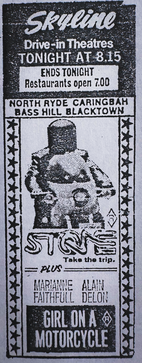
In the early 1980s, a notable biker themed triple bill was released for Australian drive in theatres. The iconic biker triple bill featured Stone, The Born Losers (1967) and The Girl on a Motorcycle (1968). Triple bill screenings were common at Australian drive ins to provide high value to patrons, often pairing older cult favorites with newer or more scandalous international titles. These screenings were often billed as 'Midnight to Dawn' or
'All Nighters, a strategy Hoyts and other chains used to combat the emerging competition from home video recorders.
'All Nighters, a strategy Hoyts and other chains used to combat the emerging competition from home video recorders.
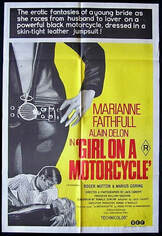
The title character of the film, Rebecca, was inspired by a real life girl on a motorcycle, the German racer Anke Eve Goldmann, a friend of the book's author, Andre Peyre Mandiargues.
The Girl on a Motorcycle, also known as Naked Under Leather (1968) is a psychedelic, erotic film starring Marianne Faithful as newlywed Rebecca, who abandons her husband to ride her Harley-Davidson motorcycle across Europe to meet her lover. The journey, depicted with vibrant 60s visuals and inner monologues, flashes back to her steamy affair, contrasting her freedom on the bike with her stifling conventional life, becoming a cult film about liberation and desire in the era of counterculture. The ending of The Girl on a Motorcycle is a shocking, fiery crash where the heroine, Rebecca dies on her motorcycle after a moment of intense, orgasmic ecstasy, symbolising her ultimate release but also the tragic consequence of her forbidden affair, with her body flying through a windshield as the credits roll. It's a famously abrupt and violent finale to her journey to meet her lover, Daniel, and leaves her fate ambiguous as to whether it's a punishment or a final, liberating act. The film was heavily edited for its initial theatrical release in Australia, where it was often shown as the X rated Naked Under Leather, with cuts made to sex scenes and nudity. DVD release restored the full version. |
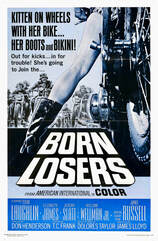
Based on a real incident in 1964 when members of the Hell's Angels motorcycle gang were arrested for assaulting five girls in Monterey, California.
The film follows Billy Jack as he attempts to live a quiet life in his airstream trailer near a small California coastal town. The town is being terrorised by a violent outlaw motorcycle gang known as 'The Born Losers', led by the ruthless Danny Carmody. The film first arrived in Australian cinemas in May 1970. Due to its depiction of violence, the initial version was heavily censored. Following the massive success of its sequel, Billy Jack, the film was re-released in Australian theaters in 1974. |
|
|
|
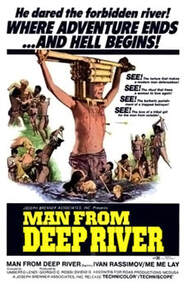
The Man From Deep River is a 1973 Italian cannibal horror film about a British photographer, John Bradley, captured by a primitive, isolated tribe in the jungles of Thailand, who endures torture, learns their ways, marries the chief's daughter, and eventually earns their respect while facing threats from rival, more violent cannibalistic clans.

The movie, directed by Umberto Lenzi, is known for its brutal scenes, graphic violence, and disturbing depictions of cannibalism, putting it in the ' video nasty' category in the UK and influencing later jungle horror films.
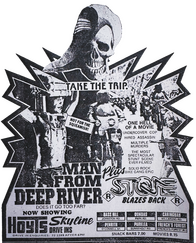
Stone and Man From Deep River was shown in various locations throughout Australia, but not limited to: Darwin, Townsville, Canberra, Port Pirie, Dubbo, Moree, Orange, Bathurst, Port Headland, Noosa, Burleigh Heads, Geelong, Wagga Wagga, Broken Hill and Fairy Meadows. Including: Cairns Coral Drive In (18-01-1980), Oxley Western Drive In (27-01-1980), Toowoomba Down Rivers Drive In (06-01-1980) and South Port Drive In, Morrochydore Drive In, Boondall Drive in and Capalaba Drive In (27-01-1980). A total of 86 venues showed the double feature Stone and Man From Deep River.
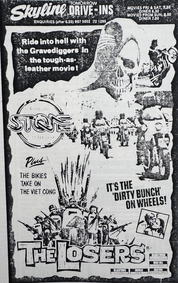
The Dare Group of Companies managed: Stone and The Losers, Stone and Man From Deep River and Stone and Women From Deep River under the name of Hot Properties, Dare Properties and Garland Productions. During 1985 Stone was distributed independently.
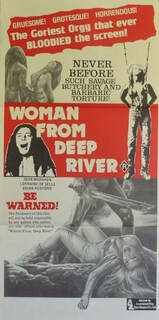
Cannibal Ferox, also known as Make Them Die Slowly in the US and as Woman from Deep River in Australia, is a 1981 Italian cannibal exploitation horror film written and directed by Umberto Lenzi. Upon its release, the film's US distributor claimed it was 'the most violent film ever made'. The title Woman from Deep River was a marketing attempt to capitalise on the success of director Umberto Lenzi's earlier 1972 film Man from Deep River.
Three friends travel to the Amazon rainforest to disprove the existence of cannibalism. They encounter two fugitives who have tortured a local tribe to find emeralds. The tribe retaliates with extreme violence and cannibalism, forcing the group to fight for survival.
Three friends travel to the Amazon rainforest to disprove the existence of cannibalism. They encounter two fugitives who have tortured a local tribe to find emeralds. The tribe retaliates with extreme violence and cannibalism, forcing the group to fight for survival.
- Starline Drive-In, Gillies Plains: Thursday 20th - Wednesday 26th June 1985, 'Stone' and 'Women From Deep River'
- Starline Drive-In, Elizabeth: Thursday 20th - Wednesday 26th June 1985, 'Stone' and 'Women From Deep River'
- Marion Drive-In, O'Halloran Hill: Thursday 20th - Wednesday 26th June 1985, 'Stone' and 'Women From Deep River'.
- Newcastle Drive In, Gateshead: Thursday 18th - Wednesday 24th July 1985, 'Stone' and 'Women From Deep River.
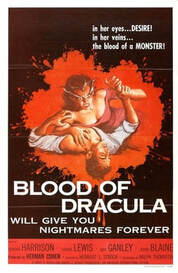
Blood of Dracula, known as Blood Is My Heritage in the United Kingdom is a 1957 American black-and-white horror film directed by Herbert L. Strock.
|
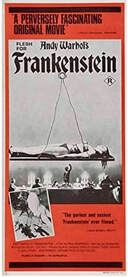
Flesh for Frankenstein (1973), also known as Andy Warhol's Frankenstein, is a cult horror film written and directed by Paul Morrissey.
Originally released in 3D, it is famous for its extreme gore, campy performances, and provocative themes including eugenics, incest, and necrophilia. |
- Rockhampton Dive In: Wednesday 13th - Tuesday 19th February 1985 'Stone', 'Blood For Dracula' and 'Flesh For Frankenstein'.
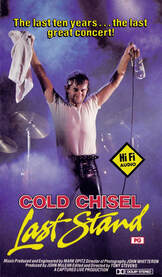
Cold Chisel Last Stand is an iconic 1984 Australian music documentary and concert film capturing the legendary pub rock band's farewell shows in December 1983 at the Sydney Entertainment Centre.
- Whitsunday Drive In, Bowen: Friday 01st - Tuesday 12th February 1985, 'Stone' and 'Cold Chisel-Last Stand'. (Cancelled due to an electricity strike in inclement weather).
- Whitsunday Drive In: Sunday 10th - Monday 11th February 1985, 'Stone' and 'Cold Chisel-Last Stand'
- Rodeo Drive In, Mareeba: Sunday 17th February 1985, 'Stone' and 'Cold Chisel-Last Stand'.
- Charter Towers Drive In, Tors Theatre: Sunday 24th February 1985, 'Stone' and 'Cold Chisel-Last Stand'
- Ayr Drive In, Stardust: Sunday 03rd March 1985, Stone' and 'Cold Chisel-Last Stand'
- Starline Drive In, Maryborough: Sunday 17th March 1985, 'Stone' and 'Cold Chisel-Last Stand'.
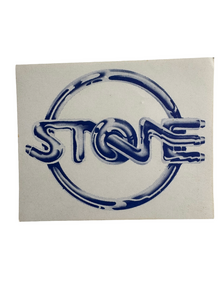
Promotional Movie Sticker Issued With Ticket Purchase At Drive In's Only To Those Who Rode There Motorcycle To Screening 1980.
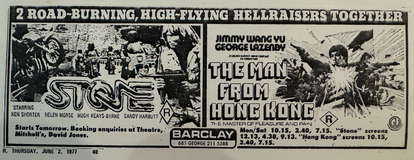
Double Feature Barclay Theatre 'Stone and The Man From Hong Kong' Thursday 02nd June 1977.
Sandy spent two years trying to get Stone into production through private investment. He applied to the Australian Film Development Corporation (AFDC) who agreed to put up two thirds of the budget. Ross Wood Productions approached Sandy about the project and agreed to put up the shooting and editing facilities as the remaining third of the budget. Sandy, AFDC and Ross Wood Productions made a contract for 'Stone' and the production finally had the green light. Ross Wood Productions only had one projector.
The contract with Greater Union Distributors expired on 29th June 1979. Sandy chose not to renew the contract for the following reasons:
a. The showing of Stone with inadequate or unsuitable films and the dividing the profits 50/ 50, even though the supporting feature would be responsible for less that 50% of takings
b. The limited marketing, promotion and advertising of Stone, stating 'since the introduction of colour television in 1976, there has been no TV commercial in colour'.
Sandy allowed GUO to honour bookings up to September 1979, with all prints being returned back to Hedon Productions in October 1979; however, after some casual bookings, Sandy came to agreement with Eric Dare Productions to double bill 'Stone' and 'Man From The Deep' on a 50/ 50 rental basis... making a colour 30 second TV commercial for the programming. During the same time, the TV rights were sold to ATN7 for a national release after Sunday 01st June 1980 for five screenings over a seven year period, for an amount of $50,000, whatever ratings were received; however, if the program received an average 25 rating in Sydney, Brisbane, Melbourne and Adelaide, the fee was to be increased to $60,000 + every average point over 25, another $5,000 would be paid.
Sandy Harbutt and the movie Stone had a difficult relationship with the Australian Film Commission, the much larger funding and marketing body that replaced the AFDC in 1975. Disputes over the handling of international sales led Sandy to buying sole rights to the film in 1980. Sandy and David Hannay then took 'Stone' to the Cannes Film Festival, achieving sales and profitable deals with Greece, Germany and Japan. Sandy refused to sell Stone to the USA as he was concerned that the actors would have their voices dubbed in American accent.
The AFC on Thursday 28th November 1975 stated 'the Commission has established a relationship with an agent in the United States who is interested in purchasing the U.S rights to Australian feature films. We would like to offer the rights of Stone and are seeking your approval to commence negotiations... we would like you to advise on the availability of a 35mm colour print, be advised that no agreement will be concluded without further consultation'
The film originally was 123 minutes long; however, after the five year agreement with BEF/ GUO Distributors expired on Tuesday 29th June 1979, Sandy shortened the film to 98 minutes for sales and further screenings. The post production on Stone was breakneck and Sandy admitted to not properly viewing the film in its entirety until the premier. Sandy thought the film was too long and planned to tighten the edit; however, the distributors were elated with the audience reaction and convinced Sandy to leave the film as it was released. When Stone had its video release in 1985, Sandy used this opportunity to create 'The Directors Cut'. He removed over 30 minutes of footage and this shortened version has been the only version since.
When Stone was released in cinemas it was 123 minutes long, where as Stone the video cassette is 95 minutes long. When a motion print is being professionally screened, it is done with two projectors. As the film on one projector ends, the other projector start, overlapping... so there is no visible pause. Sandy stated 'when I was assembling Stone, the budget was so low, that we could only afford single projector screenings, consequently when one ten minute spool of film would finish, the new spool would be put on the projector and the screening would recommence. This would take two minutes and extend the screening time from two hours to two and a half hours... this initially made it difficult for me to estimate the timing of the picture'.
The first time Sandy saw Stone professionally projected was at the word premier; thus, he thought it was overstated and long. Speaking to the distributor, he stated that he 'wanted to shorten the film'; however, they had a contractual right to screen the film as it was delivered and it was breaking box office records all around the country.
On release of the film to Japan, Germany and Britain, the film was re-edited and trimmed in parts. The 'Directors Cut released on cassette is Sandy's ultimate version.
Stone went on the recoup its budget within seven months and ran continuously around Australia for the five years of its distribution contract.
In 1993 Stone celebrated its twentieth year, with Greater Union George Street holding special midnight screenings between Friday 14th January - Sunday 27th February 1994, with extra screenings presented on Sundays at 0930pm. The media blitz covered the following: The Daily Mirror, The Sun Herald, The Sunday Telegraph, SMH, The Australian, Drum Media and 3D World Magazine. The radio promotion included; 2SER, Skidrow, 2JJJ, 2BL, 2UE and 2MMM; thus, having its fifth Sydney release (Forum, Embassy, Rapallo and Village). Sandy stated 'it was an ideal time for a theatrical release of Stone', recommending the banner 'Twentieth Anniversary Release', suggesting an opening in Sydney a week or so before the 1993 Stone Anniversary Run on Saturday 11th December 1993 would have be advantageous. Sandy had the brand new 35MM print, with the 98 minute version released by Roadshow on video... at that time, Stone had not been shown theatrically or on TV for over ten years.
The world premiere for Stone was on the 28th June 1974 at the Forum, Sydney. The critiques in the Sydney press were extremely negative, but Stone broke all attendance records at the forum; best first day, best weekend and best week, which was Greater Unions second biggest cinema in Sydney. Ken Shorter who played the name role of 'Stone' had returned to England after shooting, so the bulk of the publicity was left to Sandy Harbutt as director and co-star. Sandy embarked on a national publicity campaign to Melbourne, Brisbane, Adelaide, Perth, Newcastle, Cairns, Townsville and Surfers Paradise, leading parades of local bikers and doing press, TV and radio interviews. Stone continued its record breaking business in almost every capital city and drive-ins across the country. Within two months Stone had repaid all its distribution costs and received its first income from BEF on 20th August 1974. By the 29th January 1975, Stone had recouped its budget and had become the second biggest grossing Australian picture of all times. From that date till the end of the distribution contract in October 1979, Stone paid a profit to its investors every month.
The film has been edited multiple times - post production, directors cut, international release, Australian video release and Australian TV release. Removed scenes from the original film can be viewed on the Stone Blue-Ray DVD, released on Wednesday 07th April 2021. Umbrella Entertainment has the approval to distribute the film in all forms, until the specified agreement ends, with all future ownership of Stones intellectual copyright to be held by Sandy Harbutt's Estate.
In the opening montage of the movie Stone a Honda 450 catapults itself off the Lurline Bay Cliffs in Sydney, jumping 86ft (26.213m) and setting a world record in the process. Peter Armstrong stated before the jump 'even if I die, don't cut the shot'. On the 30th October 1977 Peter was named 'The Stuntman of the Year' at the Professional Stuntman Awards.
Sandy stated 'I wrote the motorbike jump into the script, but after looking at both sides of Sydney Heads, I couldn’t find a suitable cliff, so I told stuntman - Peter Armstrong we might have to postpone; however, about six weeks later, Peter came back saying he’d found a cliff, so off we went in his beloved Valiant Charger to Maroubra. Standing close to the edge, I said, so okay, where is it and he went, off here,.. you gotta be kidding... no, I can do it, not on my movie, I replied, and walked off... but he followed, stop, no look sir, stop, he kept saying, so he drags me back and says, we can have a ramp, I can get plenty of speed. Peter was the toughest guy I ever met; anyhow, he eventually convinced me, and a crowd of about 100 lined the cliff on the day. I explained they all had to stay back until I called cut, because it would otherwise ruin the camera work. Peter tears at the ramp like a maniac and flies into mid-air and after seven long seconds I hear a humungous splash, call cut and look over the edge, there he is, floating. He sticks his arm up, and the crowd cheers. But this was actually just an unconscious twitch – Peter later told me he couldn’t remember it... he hit, went under, got the helmet off and then somehow or other he surfaces, rolls onto his back, and is floating unconscious, once he made it into that position he passed out. When the rescuers got to him, he was asleep, and they had to fish him out. That was the worst moment of my life; I thought he was dead, but then he sat up and the crowd went wild. The boat sped off to Coogee, where an Ambulance was waiting, while I burnt back on my bike to the hospital. He’d taken a full-body impact, just like a punch to every part of your body. He’d hit the water at speed, but he could still stand, so I walked over and hugged him and the world’s humblest man, says, we did it.. no, we didn’t do it, you did it, Peter'.
Peter Armstrong 'It was the hardest impact that I have ever had in my life, I was black and blue and full of bruisers for two weeks and very still, but the shot was worth it'.
The contract with Greater Union Distributors expired on 29th June 1979. Sandy chose not to renew the contract for the following reasons:
a. The showing of Stone with inadequate or unsuitable films and the dividing the profits 50/ 50, even though the supporting feature would be responsible for less that 50% of takings
b. The limited marketing, promotion and advertising of Stone, stating 'since the introduction of colour television in 1976, there has been no TV commercial in colour'.
Sandy allowed GUO to honour bookings up to September 1979, with all prints being returned back to Hedon Productions in October 1979; however, after some casual bookings, Sandy came to agreement with Eric Dare Productions to double bill 'Stone' and 'Man From The Deep' on a 50/ 50 rental basis... making a colour 30 second TV commercial for the programming. During the same time, the TV rights were sold to ATN7 for a national release after Sunday 01st June 1980 for five screenings over a seven year period, for an amount of $50,000, whatever ratings were received; however, if the program received an average 25 rating in Sydney, Brisbane, Melbourne and Adelaide, the fee was to be increased to $60,000 + every average point over 25, another $5,000 would be paid.
Sandy Harbutt and the movie Stone had a difficult relationship with the Australian Film Commission, the much larger funding and marketing body that replaced the AFDC in 1975. Disputes over the handling of international sales led Sandy to buying sole rights to the film in 1980. Sandy and David Hannay then took 'Stone' to the Cannes Film Festival, achieving sales and profitable deals with Greece, Germany and Japan. Sandy refused to sell Stone to the USA as he was concerned that the actors would have their voices dubbed in American accent.
The AFC on Thursday 28th November 1975 stated 'the Commission has established a relationship with an agent in the United States who is interested in purchasing the U.S rights to Australian feature films. We would like to offer the rights of Stone and are seeking your approval to commence negotiations... we would like you to advise on the availability of a 35mm colour print, be advised that no agreement will be concluded without further consultation'
The film originally was 123 minutes long; however, after the five year agreement with BEF/ GUO Distributors expired on Tuesday 29th June 1979, Sandy shortened the film to 98 minutes for sales and further screenings. The post production on Stone was breakneck and Sandy admitted to not properly viewing the film in its entirety until the premier. Sandy thought the film was too long and planned to tighten the edit; however, the distributors were elated with the audience reaction and convinced Sandy to leave the film as it was released. When Stone had its video release in 1985, Sandy used this opportunity to create 'The Directors Cut'. He removed over 30 minutes of footage and this shortened version has been the only version since.
When Stone was released in cinemas it was 123 minutes long, where as Stone the video cassette is 95 minutes long. When a motion print is being professionally screened, it is done with two projectors. As the film on one projector ends, the other projector start, overlapping... so there is no visible pause. Sandy stated 'when I was assembling Stone, the budget was so low, that we could only afford single projector screenings, consequently when one ten minute spool of film would finish, the new spool would be put on the projector and the screening would recommence. This would take two minutes and extend the screening time from two hours to two and a half hours... this initially made it difficult for me to estimate the timing of the picture'.
The first time Sandy saw Stone professionally projected was at the word premier; thus, he thought it was overstated and long. Speaking to the distributor, he stated that he 'wanted to shorten the film'; however, they had a contractual right to screen the film as it was delivered and it was breaking box office records all around the country.
On release of the film to Japan, Germany and Britain, the film was re-edited and trimmed in parts. The 'Directors Cut released on cassette is Sandy's ultimate version.
Stone went on the recoup its budget within seven months and ran continuously around Australia for the five years of its distribution contract.
In 1993 Stone celebrated its twentieth year, with Greater Union George Street holding special midnight screenings between Friday 14th January - Sunday 27th February 1994, with extra screenings presented on Sundays at 0930pm. The media blitz covered the following: The Daily Mirror, The Sun Herald, The Sunday Telegraph, SMH, The Australian, Drum Media and 3D World Magazine. The radio promotion included; 2SER, Skidrow, 2JJJ, 2BL, 2UE and 2MMM; thus, having its fifth Sydney release (Forum, Embassy, Rapallo and Village). Sandy stated 'it was an ideal time for a theatrical release of Stone', recommending the banner 'Twentieth Anniversary Release', suggesting an opening in Sydney a week or so before the 1993 Stone Anniversary Run on Saturday 11th December 1993 would have be advantageous. Sandy had the brand new 35MM print, with the 98 minute version released by Roadshow on video... at that time, Stone had not been shown theatrically or on TV for over ten years.
The world premiere for Stone was on the 28th June 1974 at the Forum, Sydney. The critiques in the Sydney press were extremely negative, but Stone broke all attendance records at the forum; best first day, best weekend and best week, which was Greater Unions second biggest cinema in Sydney. Ken Shorter who played the name role of 'Stone' had returned to England after shooting, so the bulk of the publicity was left to Sandy Harbutt as director and co-star. Sandy embarked on a national publicity campaign to Melbourne, Brisbane, Adelaide, Perth, Newcastle, Cairns, Townsville and Surfers Paradise, leading parades of local bikers and doing press, TV and radio interviews. Stone continued its record breaking business in almost every capital city and drive-ins across the country. Within two months Stone had repaid all its distribution costs and received its first income from BEF on 20th August 1974. By the 29th January 1975, Stone had recouped its budget and had become the second biggest grossing Australian picture of all times. From that date till the end of the distribution contract in October 1979, Stone paid a profit to its investors every month.
The film has been edited multiple times - post production, directors cut, international release, Australian video release and Australian TV release. Removed scenes from the original film can be viewed on the Stone Blue-Ray DVD, released on Wednesday 07th April 2021. Umbrella Entertainment has the approval to distribute the film in all forms, until the specified agreement ends, with all future ownership of Stones intellectual copyright to be held by Sandy Harbutt's Estate.
In the opening montage of the movie Stone a Honda 450 catapults itself off the Lurline Bay Cliffs in Sydney, jumping 86ft (26.213m) and setting a world record in the process. Peter Armstrong stated before the jump 'even if I die, don't cut the shot'. On the 30th October 1977 Peter was named 'The Stuntman of the Year' at the Professional Stuntman Awards.
Sandy stated 'I wrote the motorbike jump into the script, but after looking at both sides of Sydney Heads, I couldn’t find a suitable cliff, so I told stuntman - Peter Armstrong we might have to postpone; however, about six weeks later, Peter came back saying he’d found a cliff, so off we went in his beloved Valiant Charger to Maroubra. Standing close to the edge, I said, so okay, where is it and he went, off here,.. you gotta be kidding... no, I can do it, not on my movie, I replied, and walked off... but he followed, stop, no look sir, stop, he kept saying, so he drags me back and says, we can have a ramp, I can get plenty of speed. Peter was the toughest guy I ever met; anyhow, he eventually convinced me, and a crowd of about 100 lined the cliff on the day. I explained they all had to stay back until I called cut, because it would otherwise ruin the camera work. Peter tears at the ramp like a maniac and flies into mid-air and after seven long seconds I hear a humungous splash, call cut and look over the edge, there he is, floating. He sticks his arm up, and the crowd cheers. But this was actually just an unconscious twitch – Peter later told me he couldn’t remember it... he hit, went under, got the helmet off and then somehow or other he surfaces, rolls onto his back, and is floating unconscious, once he made it into that position he passed out. When the rescuers got to him, he was asleep, and they had to fish him out. That was the worst moment of my life; I thought he was dead, but then he sat up and the crowd went wild. The boat sped off to Coogee, where an Ambulance was waiting, while I burnt back on my bike to the hospital. He’d taken a full-body impact, just like a punch to every part of your body. He’d hit the water at speed, but he could still stand, so I walked over and hugged him and the world’s humblest man, says, we did it.. no, we didn’t do it, you did it, Peter'.
Peter Armstrong 'It was the hardest impact that I have ever had in my life, I was black and blue and full of bruisers for two weeks and very still, but the shot was worth it'.
Stone Turns 30.
PRODUCER, director, actor and rider, Sandy Harbut, celebrated 30 years of Stone, the movie, along with 100 odd fans at Balmain Town Hall recently. The 1974 cult classic graced the silver screen along with the original Mad Max, also celebrating 25 years since its release. Locations chosen for the picture are very much the same as they were then. The race scene where the wheel standing red Norton is pitted against the black Kawasaki 9 is in and around Bent Street on the lower North Shore suburb of Sydney's Neutral Bay. This well worn route remains popular to this day and has seen many duels decided, either by oncoming traffic or by the twisting turns it provides. The Forth & Clyde Hotel in the then working class suburb of Balmain was home to the Gravediggers MC and the fight scene with their nemesis, The Blackhawks MC. The hotel lost its licence six months prior to the film's release due to it being a fair dinkum bloodhouse of a pub on Sydney's infamous waterfront. Balmain in those days supplied hard-nosed knucklemen to the shipyards. A staunch bunch of painters and dockers that didn't take shit from longhaired, dope smoking bikies. It was violence and drugs that eventually closed the hotel, which today has become offices in a suburb that has more yuppies per square foot than any other in the Harbour City. The famous motorcycle jump into the ocean was made by the big burly Peter Armstrong and shot around Maroubra. Sandy Harbut recalls talking to Armstrong about the stunt. "We wanted a scene in the film which people wouldn't forget. I had scouted around all the local cliff tops and found one about 30 ft high. I showed this one in particular to Armstrong. He took one look and said, 'Not real high' Sometime later, Armstrong took me to a place he knew.There we were standing on this huge cliff and I said to Armstrong, 'Well, where is it?' "Here, straight over there!'There"? I said with a look of amazement' I slowly walked toward the edge of a massive cliff face, speechless, and stared at the rocks below. I turned to speak to Armstrong and he motioned, pointing, 'If I get a good run up I should be able to clear the rocks down there.' I said to him, 'You're fucking insane; you'll kill yourself.'" (Ed: The jump that Armstrong was planning had never been done before. They weren't throwing a bike and a dummy off a cliff. In order for him to clear the rocks, Armstrong had to be travelling at an exact speed so as not to pitch the bike the wrong way or give it too much throttle causing the bike to spin. Once launched off the ramp, he then had to fly himself away from the near stock standard Honda in mid air to prevent the bike from hitting him or vice versa, then correct his flight through the air to land in the water at the correct angle so as not to sustain death or serious injury. All of this off a cliff 80 ft above sea level, landing in water literally 15 ft deep at high tide). Sandy remembers the day. "It all felt very risky, the life of a bloke who was a mate and respected stuntman way back in the beginning of the Australian Film Industry" It weighed heavily on the first time director's conscience. "The choice was almost too much to bear. If he had said no, it would have given me some kind of relief, but on the other hand, films are remembered for the big stunts." However, Sandy wasn't keen on pulling his mates lifeless body out of the big blue. Armstrong's will to do this stunt was amazing and he knew he could pull it off. Sandy gave the order "Action!" Camera's rolling, Armstrong made his speed and approached the ramp with pinpoint accuracy. He flew through the air just the way he said he would. The crew on the cliff didn't see Armstrong land due to camera positions. They were forced to wait until they heard the screaming engine hit the water and then a few seconds more for Armstrong to hit, then agonisingly longer for the cameraman, Graham Lind, to get his shot. That done, Sandy yelled "Cut!" The whole crew raced to the precipice with morbid curiosity only to see their leather clad stuntman floating on his back, alive and conscious. The crew were on an emotional high, the stress of such an event showing on everyone's faces. The cameramen had got his shot in one take. Not that there was going to be a second. Sandy then made his way down to the water's edge and weighed into the water to meet the rescue boat to see his mate, soaking wet, physically and mentally drained. Whatever was said between the two mates at that point, Sandy and Peter kept to themselves. The director and the stunt man then made the journey back to Sydney by boat, both staring up at the cliff face. Many years later, the big burly stuntman succumbed not to outrageous stunts but to cigarettes and bourbon. Sandy lamented, "He was the toughest man I ever knew." Other films like Kennedy Miller's Mad Max 1 & 2 would show the world that Aussie stuntman had what it takes to put realism into stunt work. More so than their Hollywood counterparts. Stone, the movie, is not regarded by many as a great Aussie film. However, the passing of time has shown to all of those black skivvy weary nerdy wordy film critic wankers that it has earned a place in Australian film culture. Evident also is the fact that tens of thousands of bikers have taken the trip up the freeway to Gosford on the Stone anniversary runs in years gone by. Including yours truly (see Ozbike Issue 59). You don't see the annual Picnic at Hanging Rock BBQ or, dare I say, The Devils Playground reunion. Or do you? Eventually Sandy wrapped the afternoon's informal Q&A session at the Town Hall in the hope that we would all piss off. Everyone made their way outside and true to form, Stone man himself, aka Mr Ken Shorter, biker and thorough gentleman, wearing his trademark white safari riding ensemble, got on his trusty old mule, gave her a kick in the guts, and when it eventually roared into life, took off down the road as if it were yesterday and he and the Gravey's were still hanging out together. Sandy donned his helmet, straddled his beautiful Kwaka resplendent with psychedelic Dave Hart custom paint job and chrome, and he too pissed off down Darling Street, Balmain, and into the night. Bikers left standing on the footpath, gearing up to head home, were heard to say "See you at the 35th Anniversary Run." Which begs the question - will there be another? If so, how many will ride - 50,000? Will the author of this little yarn ever get his biker screenplay off the ground? For this and many other unanswered questions that will probably never get answered, keep reading Ozbike. You just never know. OZ Bike Magazine 2004.
The race scene between 'Captain Midnight' and 'Stone' was done by Brian Martin and Craig Brown. Craig Brown was 'Stone' on the Norton Commando and Brian Martin was 'Captain Midnight' on the Z1 Kawasaki 900. Due to budget constraints, Sandy was hoping that Brian and Craig would perform the race 'free of charge'; however, after an half hour mexican standoff, Sandy agreed to pay them for the race. Brian stated 'It was a joy to do it but you had to deliver what the director wanted' and 'It was a bit of a tight budget operation so the roads weren’t closed off, and we had a few moments with traffic'. A huge camera was set up on the on tank of 'Captain Midnights' bike filming the instruments, with 'Stone' in front of the Z1. Brian recalled that 'one of the streets was a one-way road with an S bend and as I came into the bend pretty hot a taxi was reversing through it... that was a close call I didn't want to repeat'. As 'Captain Midnight' was an Aboriginal character who didn’t wear gloves, the production team were constantly retouching the dye on Brians hands after sweat would wash it off, before any close ups of the handlebar and controls of the Z1.
Hamish Cameron did the stunt work where 'Stone' crashes his Commando at the end of the race.
Hamish Cameron did the stunt work where 'Stone' crashes his Commando at the end of the race.

Promotional Movie Pin Issued With Ticket Purchase On Screening 1974.
Sandy owned and was riding a Triumph before it was stolen. After The Long Arm series finished, Sandy was able to purchase a new bike; however, there was a three month wait for a Triumph Trident. The dominant MC's President and SGT were both riding a Honda 750 four-cylinder roaster... 'blowing everyone away', so Sandy purchased one and 'ruled the street's', with one of the Hondas 750 accessorised with clipon's, dunstall fairings, tank and accessories. While riding these bikes Sandy had the idea about the Kawasaki Z900. During the development of the film, Sandy approached various motorcycle manufactures seeking assistance for the movie i.e. Triumph, BMW and Harley Davidson; however, even though Kawasaki thought that supplying a fleet of customised Z900s for the film was 'risking the image', Kawasaki was able to provide 16 brand new bikes free of charge with Homebush Fibreglass of Sydney making the bikini fairings, Matthew-Haritos investing to the 30 eldorado helmets and with the assistance from custom paint artist Dave Hart of M & F Choppers, it solidified the concept of what the Grave Diggers MC would ride, while Sydney resident and former International Six Day Trial gold medal winning motorcyclist Victor Hoffman worked hard to maintain the 16 bikes during the filming.
Garry McDonald 'the mechanic' repaired Stones bike at South Pacific Motorcycles. South Pacific Motorcycles was owned by Victor Hoffman, who held the pivotal role in Stone as the technical advisor and chief mechanic, tasked with keeping the fleet of Kawasaki Z1 900s in top running order for the shoot. The workshop in Gladesville was the nerve centre for the film's high performance machines.
Sandy stated to Bevan Roberts, the Sales Manager of Kawasaki Motorcycles in 1973 , 'if you loan me 16 brand new motorcycles, I will make a 90 minute Kawasaki commercial'. It took Dave Hart in a Redfern garage two weeks to personalise the paintwork on each of the 16 brand new Z900s and helmets that were delivered to him, two at a time, brand new in crates. At the completion of the movie the bikes were returned to Kawasaki for auction, except for the 'Undertakers' , '69s' and 'Buzzards'. For the Stone 25th Anniversary Run in 1998, BMW donated 6 R1200C's with the paintwork from the original bikes replicated onto tanks and fairings by Dave Hart.
The Kawazaki 900s arrived at Dave Harts workshop in original condition, removing the pillion rails and fitting flat bars and bikini fairings. Dave Hart personalised the paintwork on each of the 16 Z1 Kawasaki 900s to represent its rider and made recommendation that 'only the women have open face and painted helmets'. The Grave Digger helmets are black to help disguise the rider from the audience to permit interchangeability of rider for stunt work. All the cast members were offered to purchase the bikes at half price; however, since most of the cast had their own bikes, only Sandy, Tim and Mike took up the offer. The 'Undertakers' bike went to Tim Storrier, '69s' bike went to Sandy and Mike Robinson took 'Buzzards' bike, with the rest of the bikes being returned to Kawasaki for auction.
It could be stated that the star of the film Stone is the Z1 Kawasaki 900; however, as you watch the fight scene between the BlackHawks and Grave Diggers, the depiction of Australian 1970s motorcycle culture at that time is on display as the BlackHawks ride into town on Kawasaki, Harley Davidson, Ducati and Norton’s. Sandy stated 'I deliberately broke the rules and put Grave Diggers on Kawasaki 900s and it was a serious point of contention at the time. The fact is, that once you rode them, they were just the best bike on the planet, fast, tough and reliable. I guessed that the Grave Diggers back from Vietnam wouldn't care what others would think. During the shooting various people would turn up and debate the choice in bike... but not prepared to try a compare test around the block or any block... no one was prepared to even do a burnout or wheelie competition. All the Grave Diggers were excellent riders; except one'.
Bevan Roberts, the Sales Manager of Kawasaki Motorcycles in 1973 invested $50,000 (the cost of the bikes) into the movie, stating 'after the pictures success, Kawasaki had sold more Z900s per capita, in Australia than any other country in the world.' Sandy was riding a Triumph Trident before it was stolen and Ken Shorter rode a Norton Commando as his daily mode of transport
Stone featured 36 different characters, 14 of which were female, with 8 of the cast members receiving advanced tuition at the Willoughby District Motorcycle Club Training School at Seven Hills. Two top motorcycle races also agreed to support production - motor cross racer Brian Martin and road racer Garry Thomas
Garry McDonald 'the mechanic' repaired Stones bike at South Pacific Motorcycles. South Pacific Motorcycles was owned by Victor Hoffman, who held the pivotal role in Stone as the technical advisor and chief mechanic, tasked with keeping the fleet of Kawasaki Z1 900s in top running order for the shoot. The workshop in Gladesville was the nerve centre for the film's high performance machines.
Sandy stated to Bevan Roberts, the Sales Manager of Kawasaki Motorcycles in 1973 , 'if you loan me 16 brand new motorcycles, I will make a 90 minute Kawasaki commercial'. It took Dave Hart in a Redfern garage two weeks to personalise the paintwork on each of the 16 brand new Z900s and helmets that were delivered to him, two at a time, brand new in crates. At the completion of the movie the bikes were returned to Kawasaki for auction, except for the 'Undertakers' , '69s' and 'Buzzards'. For the Stone 25th Anniversary Run in 1998, BMW donated 6 R1200C's with the paintwork from the original bikes replicated onto tanks and fairings by Dave Hart.
The Kawazaki 900s arrived at Dave Harts workshop in original condition, removing the pillion rails and fitting flat bars and bikini fairings. Dave Hart personalised the paintwork on each of the 16 Z1 Kawasaki 900s to represent its rider and made recommendation that 'only the women have open face and painted helmets'. The Grave Digger helmets are black to help disguise the rider from the audience to permit interchangeability of rider for stunt work. All the cast members were offered to purchase the bikes at half price; however, since most of the cast had their own bikes, only Sandy, Tim and Mike took up the offer. The 'Undertakers' bike went to Tim Storrier, '69s' bike went to Sandy and Mike Robinson took 'Buzzards' bike, with the rest of the bikes being returned to Kawasaki for auction.
It could be stated that the star of the film Stone is the Z1 Kawasaki 900; however, as you watch the fight scene between the BlackHawks and Grave Diggers, the depiction of Australian 1970s motorcycle culture at that time is on display as the BlackHawks ride into town on Kawasaki, Harley Davidson, Ducati and Norton’s. Sandy stated 'I deliberately broke the rules and put Grave Diggers on Kawasaki 900s and it was a serious point of contention at the time. The fact is, that once you rode them, they were just the best bike on the planet, fast, tough and reliable. I guessed that the Grave Diggers back from Vietnam wouldn't care what others would think. During the shooting various people would turn up and debate the choice in bike... but not prepared to try a compare test around the block or any block... no one was prepared to even do a burnout or wheelie competition. All the Grave Diggers were excellent riders; except one'.
Bevan Roberts, the Sales Manager of Kawasaki Motorcycles in 1973 invested $50,000 (the cost of the bikes) into the movie, stating 'after the pictures success, Kawasaki had sold more Z900s per capita, in Australia than any other country in the world.' Sandy was riding a Triumph Trident before it was stolen and Ken Shorter rode a Norton Commando as his daily mode of transport
Stone featured 36 different characters, 14 of which were female, with 8 of the cast members receiving advanced tuition at the Willoughby District Motorcycle Club Training School at Seven Hills. Two top motorcycle races also agreed to support production - motor cross racer Brian Martin and road racer Garry Thomas
In the funeral run scene from the movie Stone, 400 bikes showed up to support the filming. It is estimated that all motorcycle riders in Sydney attended this event, including the outlaw motorcycle clubs. The funeral scene is recognised as an event of great significance in Australian biker history, as it represents the moment when 'all clubs' came together for the first time in Australia. The initial filming of the Memorial Run was held on Saturday 08th December 1973. The 20th Memorial Run was held on the Saturday 11th December 1993 and the 25th Anniversary Run was held on Saturday 12th December 1998; thus, all proceeding Memorial Runs post initial run have been conducted on the 2nd Saturday in December.
Leading the funeral run were the Grave Diggers followed by the Dominant MC who supported filming throughout the production. Sandy refused to permit the females to ride pillion during this scene, making recommendation that all females would be transported by bus to Gore Hill Cemetery, St Leonards, to avoid any complications that might arise with other MC's attending the run. Margaret 'Jay' Ure stated 'The females were dark that they were not permitted to be in the opening scene riding up the freeway'. Some of the extras for the funeral scene were the Hells Angels, Indian Pacific and El Condors from Armidale.
Ride Order: Vince Tesorero with 'Go Down' in the casket, 'Undertaker', 'Toad', 'Hooks' & 'Dr Death' as pillion, 'Dewey', Septic', 'Pinball', 'Captain Midnight', 'Bad Max', 'Zonk'.
In 1991 Sandy Harbutt sought assistance from the Australian Film Commission (AFC) and requested a loan of $1,999.26 to make payment to the management of the Film Vault for the storage of Stone - original negatives, 35mm prints and sound tracks. On Monday 06th May 1991 the Film Vault management sought payment for storage and Sandy Harbutt was asked by the Film Vault to remove all Stone material by Friday 10th May 1991 if payment was not made immediately. On the 27th May 1991 the AFC advised Sandy Harbutt that because they had no current financial involvement in Stone, they were unable to meet the request and directed Sandy Harbutt to store material in a cool, dry even temperature environment. This was also during the time that the National Film and Sound Archives did not have the appropriate storage facilities
Leading the funeral run were the Grave Diggers followed by the Dominant MC who supported filming throughout the production. Sandy refused to permit the females to ride pillion during this scene, making recommendation that all females would be transported by bus to Gore Hill Cemetery, St Leonards, to avoid any complications that might arise with other MC's attending the run. Margaret 'Jay' Ure stated 'The females were dark that they were not permitted to be in the opening scene riding up the freeway'. Some of the extras for the funeral scene were the Hells Angels, Indian Pacific and El Condors from Armidale.
Ride Order: Vince Tesorero with 'Go Down' in the casket, 'Undertaker', 'Toad', 'Hooks' & 'Dr Death' as pillion, 'Dewey', Septic', 'Pinball', 'Captain Midnight', 'Bad Max', 'Zonk'.
In 1991 Sandy Harbutt sought assistance from the Australian Film Commission (AFC) and requested a loan of $1,999.26 to make payment to the management of the Film Vault for the storage of Stone - original negatives, 35mm prints and sound tracks. On Monday 06th May 1991 the Film Vault management sought payment for storage and Sandy Harbutt was asked by the Film Vault to remove all Stone material by Friday 10th May 1991 if payment was not made immediately. On the 27th May 1991 the AFC advised Sandy Harbutt that because they had no current financial involvement in Stone, they were unable to meet the request and directed Sandy Harbutt to store material in a cool, dry even temperature environment. This was also during the time that the National Film and Sound Archives did not have the appropriate storage facilities
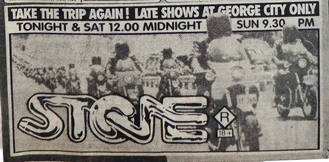
In 1993 Stone celebrated its twentieth year, with Greater Union George Street holding special midnight screenings between Friday 14th January - Sunday 27th February 1994. On Sunday 16 January 1994 a member of the public wrote to GU stating 'they had travelled 220km to watch the film Stone with their partner only to be dissatisfied with the heavily edited version, expecting to see the original uncut version'. On receipt of this letter, Sandy responded via mail, thanking the individual for writing the letter, explaining the reasons for his amended version of the film, promptly refunded their money, forwarded a video of a directors cut of Stone to there residential address and changing the GU marketing advertisement from 'Take The Trip Again' to 'Take The Trip - The Directors Cut'.
Stone 20th Anniversary Memorial Run Patch 1993.
At 09.30am Saturday 11th December 1993 a 20th Memorial Stone Run was held by the VVMC NSW Chapter and the Kawasaki Z Owners of Victoria. The run commenced at Lane Cove Road, North Ride, facing Epping Highway, took three hours to complete, with the 'pack of bikes' stretching twenty six kilometres. The VVMC intent for this event was to confer licensing of 'Casper' to the VVMC and as stated by the NSW VVMC Road Captain at the time, 'end any or all involvement associated with or inferred that this Club, the Vietnam Veterans is in anyway fictional or a bunch of actors'; however, differences arose between Sandy and the VVMC at the last minute and the handover didn't occur as intended. Organisers approximated 5000 bikes would attend but numbers exceeded 12,000. Sandy did not want to just celebrate Stone but the ideology of 'Take the Trip'. The coming together of all motorcycle riders, clubs and what it means to be part of biker culture.
The funeral procession of over four hundred motorcyclists on the Newcastle Expressway, was shot in December 1973 and it was agreed to re-enact the procession in December 1993. A party site with facilities and entertainment was arranged near Newcastle and all motorcyclists were invited to attend through the motorcycle press. As they had twenty years before, NSW police agreed to co-ordinate traffic for the ride from Lane Cove to Newcastle. Twelve thousand motorcyclists were estimated by police and the motorcycle press to have participated in the 'Stone Run' on Saturday 11th December 1993, the largest ever gathering of motorcycles in Australia. The success of the Stone Run in 1993, led negotiations for a re-release of the movie Stone at the Greater Union complex in George Street, Sydney in January and February 1994 and a booking for the Melbourne Fringe Festival in October 1994. Stone was also sold to SBS TV for three screenings and in its first, in October 1994, it was SBS highest rating picture of the year.
Adrian Martim wrote in The Age 'Sandy Harbutt's film has carved out an indelible space for itself in Australian popular culture... the film also provides a fascinating and entertaining road map to the Australian cinema that followed it - perhaps not the offical history enshrined in books, but maybe a more important and vital one' and Peter Castaldi wrote in the Sunday Herald Sun 'deserves its cult status on the pantheon of 0Z Films... sits on the list of the most successful Australian films ever made'.
The funeral procession of over four hundred motorcyclists on the Newcastle Expressway, was shot in December 1973 and it was agreed to re-enact the procession in December 1993. A party site with facilities and entertainment was arranged near Newcastle and all motorcyclists were invited to attend through the motorcycle press. As they had twenty years before, NSW police agreed to co-ordinate traffic for the ride from Lane Cove to Newcastle. Twelve thousand motorcyclists were estimated by police and the motorcycle press to have participated in the 'Stone Run' on Saturday 11th December 1993, the largest ever gathering of motorcycles in Australia. The success of the Stone Run in 1993, led negotiations for a re-release of the movie Stone at the Greater Union complex in George Street, Sydney in January and February 1994 and a booking for the Melbourne Fringe Festival in October 1994. Stone was also sold to SBS TV for three screenings and in its first, in October 1994, it was SBS highest rating picture of the year.
Adrian Martim wrote in The Age 'Sandy Harbutt's film has carved out an indelible space for itself in Australian popular culture... the film also provides a fascinating and entertaining road map to the Australian cinema that followed it - perhaps not the offical history enshrined in books, but maybe a more important and vital one' and Peter Castaldi wrote in the Sunday Herald Sun 'deserves its cult status on the pantheon of 0Z Films... sits on the list of the most successful Australian films ever made'.
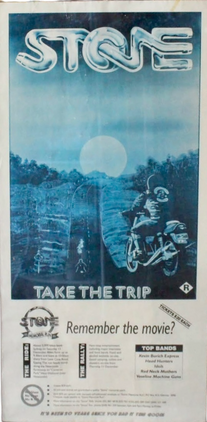
Stone 20th Anniversary Memorial Run Promotional Poster.
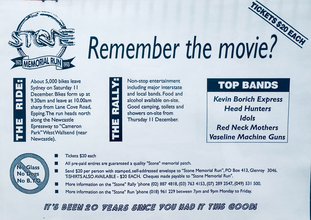
'Remember The Movie' 1993.
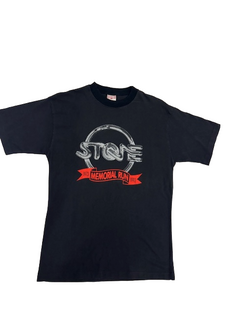
Stone Memorial Run T Shirt 1973-1993.
|
Stone Memorial Run T Shirt 1973-1993.
|
The National Organisational Committee consisted of Sandy Harbutt (Stone), Trevor Thomas (freelance journalist), Boris Mihailovich, Bob Skol and Laurie Keats (OZ Bikes), Mike Esdaile from Federal Publishing (Two Wheels, Street Bike, Live to Ride and Revs Motorcycle News Magazine), Vince Tesseriro (Forcefield Marketing), Hush (VVMC), Lindsay Roberts and Dean Mighell (Kawasaki Z Owners Club). The event was conducted in two parts - VVMC managing the Stone Memorial Run up the Newcastle Expressway, Z Owners managing the alcohol, merchandise, gate fees, security, with a promoter organising the entertainment. Express, Redneck Mothers, Kevin Borich, Idols, Vaseline Machine Gun and Head Hunters were part of the entertainment, with the girls from X-Ray Tracy performing three shows. The live entertainment commenced at 1400 Saturday, concluding 0400 Sunday.
Those that pre-paid for the event got a memorial patch and 6 alcoholic cans per entry. Profits for the event: 5% Legacy with the remainder divided between the VVMC NSW Chapter and the Kawasaki Z Owners, Victoria. Any profits from the sale of t-shirts in each state remained in the state of sale for the VVMC.
The three piece patch Grave Diggers 'Casper' started to be worn by VVMC members from 1992; however, this varied from state to state, as approval had to be sought and given by the dominate MC's e.g. NSW were wearing their three piece patch in 1992; however, WA commenced wearing their three piece patch from 1996. Sandy states 'he first became aware of the use of 'Casper' by the VVMC in late 1992'.
The most important event in the Veterans club events calendar are the 'Stone Runs', which are compulsory for all members and are held periodically. The name Stone was first used in the clubs first run in 1990, which had a 1960's biker theme and featured the Rolling Stones music and the showing of the 1974 movie Stone.
Those that pre-paid for the event got a memorial patch and 6 alcoholic cans per entry. Profits for the event: 5% Legacy with the remainder divided between the VVMC NSW Chapter and the Kawasaki Z Owners, Victoria. Any profits from the sale of t-shirts in each state remained in the state of sale for the VVMC.
The three piece patch Grave Diggers 'Casper' started to be worn by VVMC members from 1992; however, this varied from state to state, as approval had to be sought and given by the dominate MC's e.g. NSW were wearing their three piece patch in 1992; however, WA commenced wearing their three piece patch from 1996. Sandy states 'he first became aware of the use of 'Casper' by the VVMC in late 1992'.
The most important event in the Veterans club events calendar are the 'Stone Runs', which are compulsory for all members and are held periodically. The name Stone was first used in the clubs first run in 1990, which had a 1960's biker theme and featured the Rolling Stones music and the showing of the 1974 movie Stone.
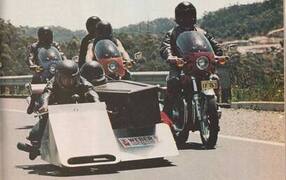
Bob Levi's Wedge Road Racing Outfit. Vince Tesorero from Willoughby District Motorcycle Club recruited a large portion of the riders for this scene in the movie & rode the coffin side car. Bruce McPherson was 'Go Down'. This was Vince's only appearance in the movie.
Built and raced by Australian motorsport legend Bob Levy, the iconic Chesterfield "Wedge" sidecar earned a permanent place in pop culture when it was used to carry the coffin of "Go Down" in the classic movie Stone. Following its famous silver screen appearance, the machine suffered a severe crash on the track and was eventually lost to time before being meticulously restored by sidecar guru Beau and Bob Levy himself.
Built and raced by Australian motorsport legend Bob Levy, the iconic Chesterfield "Wedge" sidecar earned a permanent place in pop culture when it was used to carry the coffin of "Go Down" in the classic movie Stone. Following its famous silver screen appearance, the machine suffered a severe crash on the track and was eventually lost to time before being meticulously restored by sidecar guru Beau and Bob Levy himself.
Stone 20th Anniversary Memorial Run 1993.
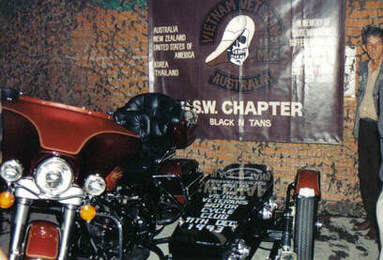
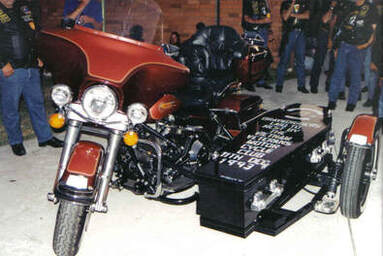
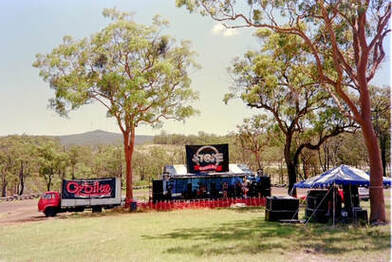
Organisers were astonished by the response and a few logistical problems arose. One of them involving the coffin that was scheduled to lead the run... it was held up in a traffic jam which was caused by the unbelievable number of motorbikes gathering in Lane Cove Road. A three lane road was cut into one slow moving lane as bikes manoeuvred to park and wait. When it became apparent that the coffin was not going to arrive on time, the run was started, minus the lead bike. The 'Undertaker' was the only Grave Digger to attended the Stone 20th Memorial Run and chose to return to Sydney after crossing the Hawkesbury River Road Bridge.
To control the amount of bikes on the road, police staggered the groups of riders; thus, this meant that at no time was everyone riding together.
Z Owners President at the time stated 'this run was like ANZAC Day for bikers. We all rode remembering our mates and to celebrate motorcycling. There is obvious a place in the motorcycling community for an event where bikes from all sections of motorcycling can come together and celebrate the very thing we share; riding bikes, Stone was such an event'.
Harleys In Australia Magazine... 'we had a blast riding through the pack, hundreds of spectators crowded the overpasses, cheering the massive procession through, hands were raised in salute, faces were cracked open with huge grins, the overwhelming feeling of togetherness and family shook you to the very core. This was what it was all about, it didn't matter what you were riding, just that you were a part of it'.
In 1992 Sandy was approached by the NSW members of the VVMC seeking approval to use the Grave Diggers centre piece from the movie Stone, commonly known as 'Casper' (Skull and Slouch Hat). In 1997 Sandy officially and legally licensed Vietnam Veterans Australia MC to wear the Skull and Diggers Hat symbol (identical to the emblem worn by the Grave Diggers MC Sydney in Stone) together with the words Vietnam Veterans MC. The licence establishes that the VVMC have full legal and moral rights to the colours. He stated that 'approval for its use was done out of respect and admiration for the Vietnam Veterans, believing that the VVMC deserved to wear the Skull and Digger Hat symbol by reason of their service and that he had designed the symbol for a group of alienated ex-servicemen... Grave Diggers MC'.
To control the amount of bikes on the road, police staggered the groups of riders; thus, this meant that at no time was everyone riding together.
Z Owners President at the time stated 'this run was like ANZAC Day for bikers. We all rode remembering our mates and to celebrate motorcycling. There is obvious a place in the motorcycling community for an event where bikes from all sections of motorcycling can come together and celebrate the very thing we share; riding bikes, Stone was such an event'.
Harleys In Australia Magazine... 'we had a blast riding through the pack, hundreds of spectators crowded the overpasses, cheering the massive procession through, hands were raised in salute, faces were cracked open with huge grins, the overwhelming feeling of togetherness and family shook you to the very core. This was what it was all about, it didn't matter what you were riding, just that you were a part of it'.
In 1992 Sandy was approached by the NSW members of the VVMC seeking approval to use the Grave Diggers centre piece from the movie Stone, commonly known as 'Casper' (Skull and Slouch Hat). In 1997 Sandy officially and legally licensed Vietnam Veterans Australia MC to wear the Skull and Diggers Hat symbol (identical to the emblem worn by the Grave Diggers MC Sydney in Stone) together with the words Vietnam Veterans MC. The licence establishes that the VVMC have full legal and moral rights to the colours. He stated that 'approval for its use was done out of respect and admiration for the Vietnam Veterans, believing that the VVMC deserved to wear the Skull and Digger Hat symbol by reason of their service and that he had designed the symbol for a group of alienated ex-servicemen... Grave Diggers MC'.
Stone 25th Anniversary Run Patch 1998.
On Saturday 12th December 1998, the licensing of 'Casper' to VVMC aligned with the 1998 Stone 25th Anniversary Run, where 30,000 motorcyclists gathered in Sydney to mark the anniversary of the film and recreate the funeral ride, departing from the old toll gates at Berowra on the outskirts of Sydney, up the coast road to Burleigh Ranch, Raymond Terrace. The VVMC accepted the invitation by Sandy to lead the 25th Anniversary Ride, directly behind the Grave Diggers, who wore the original colours in honour of the event.
Sandy asked Vince 'to have the 1998 Stone 25th Anniversary pin designed in a tubular gold... the circle around the Stone is to be a complete tube and the Stone itself is to be half tube'.
Sandy asked Vince 'to have the 1998 Stone 25th Anniversary pin designed in a tubular gold... the circle around the Stone is to be a complete tube and the Stone itself is to be half tube'.
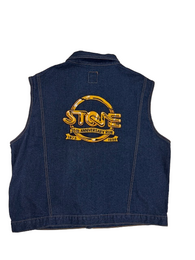
Vests were available for purchase at the Stone 25th Anniversary event only and were not available on the Stone online store.

Stone 25th Anniversary t shirt available at the event.
Original items are labelled by ICON and will have 'Take The Trip' phrase at the bottom of Stone tube emblem.
Original items are labelled by ICON and will have 'Take The Trip' phrase at the bottom of Stone tube emblem.
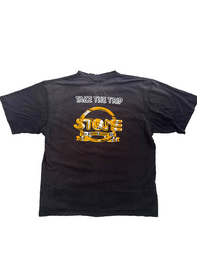
'Stone 25th Anniversary Logo Front Breast Print and Big Logo Back Print + Take The Trip'.
Stoneweb.com
Sixteen items were available for purchase on the Stone website promoting the Stone 25th Anniversary Run.
The online items for sale were made by Stone Gear and Johnny Bobbins.
Phrase 'Take The Trip' is located at the top of the shirt in the online products.
There is a 'folktale' that the Stone 25th Anniversary Black Felt Body Leather Jacket were made in limited quantities and were only issued to Grave Diggers; however, they were readily available for purchase on Stoneweb.com at a cost of $315.00.
Jackets are ICON labelled.
'Stone 25th Anniversary Logo Breast Print and Big Skull Back Print... all embodied'.
Stoneweb.com
One of the rare clothing items is the Stone 25th Anniversary Ladies Boob Tube.
Stoneweb.com
Sixteen items were available for purchase on the Stone website promoting the Stone 25th Anniversary Run.
The online items for sale were made by Stone Gear and Johnny Bobbins.
Phrase 'Take The Trip' is located at the top of the shirt in the online products.
There is a 'folktale' that the Stone 25th Anniversary Black Felt Body Leather Jacket were made in limited quantities and were only issued to Grave Diggers; however, they were readily available for purchase on Stoneweb.com at a cost of $315.00.
Jackets are ICON labelled.
'Stone 25th Anniversary Logo Breast Print and Big Skull Back Print... all embodied'.
Stoneweb.com
One of the rare clothing items is the Stone 25th Anniversary Ladies Boob Tube.

Big Stone Movie logo Front Print and Back Print
'I Took The Trip'. Stoneweb.com |

Back Print 'I Took The Trip'.
Stoneweb.com |
On one hand there was the tragic motorcycle road accident and on the other hand it was the largest biker event in Australian history. A member of the Maitland Gladiators MC was killed when 50 motorcycles crashed during the commemorative ride on the F3 motorway... at the cobbs road overpass near Tuggerah, north of Sydney. One member of the ride died and thirteen riders were injured including Angry Anderson, who sustained a broken arm, neck injuries, broken finger, bruised spine and concussion. Angry Anderson who is the lead singer of Rose Tattoo and patron to the VVMC NSW Chapter stated 'there were just bikes and bodies everywhere... I was in the second wave that crashed and went over... there were bikes and bodies flying through the air, it all happened so quickly, there were so many bikes, I saw everything in slow motion, I have been having flashes of it all day... we got hit in the front wheel by a flying bike, I went straight over the top of the bike, then one or two bikes went over me, the next thing I remember I was laying on the side of the road... I always wore full leathers and a helmet and was grateful for the protection, as I remember coming down hard on my head and shoulders'.
Police stated that 'a motorcycle and a small red car coming onto the freeway from an entrance ramp collided, triggering a huge pile-up that brought 50 riders crashing down'. Entertainer Normie Rowe said 'some of the riders were travelling too fast when a car, a Daihatsu Charade entered the motorway'. The Stone Run ended for many riders at the accident, with dozens injured and riders getting 'thumped' by outlaws enraged over the loss of their brother. The freeway was closed in both direction for 5 hours, causing a 4km back-up of traffic and long delays as space was cleared for the two rescue helicopters to land at the scene.
NRMA Careflight crewman stated that 'there were smashed bikes all over the road and injured riders sprawled between them... it was an absolute mess'. Sandy summed it up the best after listening to 'Alice' from the Gladiators MC speaking on stage on the loss of fellow Gladiator 'Herm' earlier in the day. 'I guess it covers every emotion, mutual bliss, to complete loss, to complete failure, the feelings of having killed somebody... the culture dictates that tragedy must be overcome through the celebration of life'.
Police stated that 'a motorcycle and a small red car coming onto the freeway from an entrance ramp collided, triggering a huge pile-up that brought 50 riders crashing down'. Entertainer Normie Rowe said 'some of the riders were travelling too fast when a car, a Daihatsu Charade entered the motorway'. The Stone Run ended for many riders at the accident, with dozens injured and riders getting 'thumped' by outlaws enraged over the loss of their brother. The freeway was closed in both direction for 5 hours, causing a 4km back-up of traffic and long delays as space was cleared for the two rescue helicopters to land at the scene.
NRMA Careflight crewman stated that 'there were smashed bikes all over the road and injured riders sprawled between them... it was an absolute mess'. Sandy summed it up the best after listening to 'Alice' from the Gladiators MC speaking on stage on the loss of fellow Gladiator 'Herm' earlier in the day. 'I guess it covers every emotion, mutual bliss, to complete loss, to complete failure, the feelings of having killed somebody... the culture dictates that tragedy must be overcome through the celebration of life'.
The inquest into the accident and passing of 'Herm' was held at the Coroners Court at Gosford on the 22nd September 1999. The coroner went on to criticise the lack of police coordination with only four bike cops and two police cars supporting; however, Sandy Harbutt had paid $10,000 for a user pay police service and request more to be present at the event. Sandy stated 'there probably will be approximately 15,000 bikes in attendance' and requested a visible police presence for road closures and traffic control. The coroner criticised the Mount Kuringai Highway Patrol for going ahead with the event, when they realised their prediction of bikes attending was underestimated.
The coroner made four recommendations:
1. That the NSW Police Service consider applying the provisions in relation to Public Assemblies pursuant to Section 93 of the Summary Offences Act 1998 (NSW) to any future processions of motorcycles similar to the Stone Anniversary Ride
2. That when the N.S.W Police Service is notified of an event such as the Stone Anniversary Ride, the organisers or promotors be requested to provide details in accordance with the notice requirements under Section 23 of the Summary Offences Act, 1988 (NSW)
3. That the NSW Police Service ensure adequate supervision of the event, including commencement, movement and completion of the event in accordance with any NSW Police Guidelines for such an event, so as to ensure a high Police visibility and to maintain peace and good order
4. That the NSW Police Service consider opposing any such Public Assembly unless the follow conditions are observed for the purpose Public Safety:
a. That the NSW Police Service ensure that such conditions be imposed in relation to the travel alone the route of the event to ensure public safety, including safe entry, exit and passage along the road and any other conditions that the NSW Police Service deem appropriate
b. That the organisers or promoters be required to supply at their expense portable signage along the route of the procession notifying the general public and participants of any directions as to where to travel during the procession.
Sandy Harbutt and David Hannay contacted SBS with details of the Stone 25th Anniversary Run and the potential for a documentary to be framed around the movie. The idea didn't initially win favour with SBS, but with support from Margaret Pomeranz and Spectrum Films behind the project with post production facilities, approval was granted... it was known around SBS as 'that bikie doco'. The 'Stone Feeling' made this documentary possible. What was lacking in budget was made up through goodwill generated by a film supported by a motorcycle community. Companies supplied everything from stock footage, to music rights, to camping gear at low rates... because it was Stone.
In 1990 the NSW members of the VVMC approached the dominant Outlaw Motorcycle Chapter (OMC) and sought assistance to submit a proposal to commence a Vietnam Veterans - Three Piece Patch Motorcycle Club to the Outlaw Motorcycle Council. The President of the dominant OMC took the VVMC request to the Outlaw Motorcycle Council (a co-op of the five senior 1% Clubs) to start the VVMC as a three piece back patch club. Approval was given by the Outlaw Motorcycle Council after negotiations spanning a total of three years. Approval was given on the following conditions:
1. The VVMC were not permitted to use the same colours as the Grave Diggers MC (red, white and blue)
2. The initial VVMC Club colours were to be black and tan (NSW Chapter during initial request had its colours as black and gold, and amended their colours to black and tan to avoid any confusion about their identity within the biker community; thus, the NSW Chapter of the VMC is the only Chapter to have its colours, black and tan, while the rest of the Chapters are black and gold)
3. The VVMC were not to use the 1% diamond on their cut-off
4. The VVMC was to have a sunset clause; thus, in the agreement, when the last VVMC member died so did the VVMC colours
5. Only those who had been deployed into active service in Vietnam were permitted to wear the VVMC back patch.
The coroner made four recommendations:
1. That the NSW Police Service consider applying the provisions in relation to Public Assemblies pursuant to Section 93 of the Summary Offences Act 1998 (NSW) to any future processions of motorcycles similar to the Stone Anniversary Ride
2. That when the N.S.W Police Service is notified of an event such as the Stone Anniversary Ride, the organisers or promotors be requested to provide details in accordance with the notice requirements under Section 23 of the Summary Offences Act, 1988 (NSW)
3. That the NSW Police Service ensure adequate supervision of the event, including commencement, movement and completion of the event in accordance with any NSW Police Guidelines for such an event, so as to ensure a high Police visibility and to maintain peace and good order
4. That the NSW Police Service consider opposing any such Public Assembly unless the follow conditions are observed for the purpose Public Safety:
a. That the NSW Police Service ensure that such conditions be imposed in relation to the travel alone the route of the event to ensure public safety, including safe entry, exit and passage along the road and any other conditions that the NSW Police Service deem appropriate
b. That the organisers or promoters be required to supply at their expense portable signage along the route of the procession notifying the general public and participants of any directions as to where to travel during the procession.
Sandy Harbutt and David Hannay contacted SBS with details of the Stone 25th Anniversary Run and the potential for a documentary to be framed around the movie. The idea didn't initially win favour with SBS, but with support from Margaret Pomeranz and Spectrum Films behind the project with post production facilities, approval was granted... it was known around SBS as 'that bikie doco'. The 'Stone Feeling' made this documentary possible. What was lacking in budget was made up through goodwill generated by a film supported by a motorcycle community. Companies supplied everything from stock footage, to music rights, to camping gear at low rates... because it was Stone.
In 1990 the NSW members of the VVMC approached the dominant Outlaw Motorcycle Chapter (OMC) and sought assistance to submit a proposal to commence a Vietnam Veterans - Three Piece Patch Motorcycle Club to the Outlaw Motorcycle Council. The President of the dominant OMC took the VVMC request to the Outlaw Motorcycle Council (a co-op of the five senior 1% Clubs) to start the VVMC as a three piece back patch club. Approval was given by the Outlaw Motorcycle Council after negotiations spanning a total of three years. Approval was given on the following conditions:
1. The VVMC were not permitted to use the same colours as the Grave Diggers MC (red, white and blue)
2. The initial VVMC Club colours were to be black and tan (NSW Chapter during initial request had its colours as black and gold, and amended their colours to black and tan to avoid any confusion about their identity within the biker community; thus, the NSW Chapter of the VMC is the only Chapter to have its colours, black and tan, while the rest of the Chapters are black and gold)
3. The VVMC were not to use the 1% diamond on their cut-off
4. The VVMC was to have a sunset clause; thus, in the agreement, when the last VVMC member died so did the VVMC colours
5. Only those who had been deployed into active service in Vietnam were permitted to wear the VVMC back patch.
Veterans Motorcycle Club Stone Tribute Ride Patch 2017.
|
Stone Rally Run Dubbo Patch 2021.
|
Stone Ride and Rage Run Patch Dubbo 2022.
|
Stone Commemorative Patch 51 Years Patch 2024.
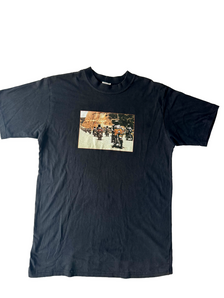
Stone 25th Anniversary T Shirt
1974-1999 'Take The Trip'. |
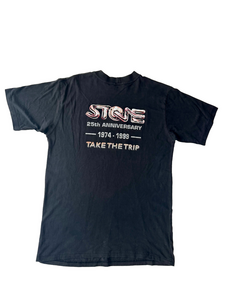
Stone 25th Anniversary T Shirt 1974-1999. 'Take The Trip'.
|
Stone Social Club Patch.
On the 10th November 1998 a group of some thirty odd hard core motorcyclist and Stone fans meet at the old toll gates at Berowra, braving torrential rain and freezing conditions to attend a meeting in which Sandy Harbutt officially endorsed the formation of the Stone Social Club.
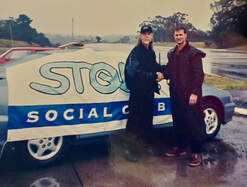
'The new Stone Social Club banner is displayed prominently to show the depth of support that these group of people felt'.
Stone Social Club newsletter April - May 1999.
Stone Social Club newsletter April - May 1999.

Stone Social Club Challenge Coin.
Live to Ride Magazine, The Australian Biker's Journal was founded in 1988. It quickly became and remains one of the premier lifestyle motorcycle magazines in Australia and New Zealand, covering various facets of bike culture. From the beginning, it established itself as a lifestyle magazine, encompassing everything from cruisers and customs to classics, alongside features on events, products, tattoos, and rock and roll.
In May 2011, publication responsibilities shifted to Express Media Group (EMG), who operated from Silverwater, N.S.W. It is currently published by Miles Of Words Media. The magazine has consistently recognised the lasting effect and cult following of Stone, which is considered the definitive portrayal of the Australian bikie lifestyle. The magazine has featured retrospective articles, covered memorial rides, and highlighted the bikes used in the film, such as the Kawasaki Z900.
In May 2011, publication responsibilities shifted to Express Media Group (EMG), who operated from Silverwater, N.S.W. It is currently published by Miles Of Words Media. The magazine has consistently recognised the lasting effect and cult following of Stone, which is considered the definitive portrayal of the Australian bikie lifestyle. The magazine has featured retrospective articles, covered memorial rides, and highlighted the bikes used in the film, such as the Kawasaki Z900.
Live To Ride Magazine Volume 6 Issue 12 December 1993.
|
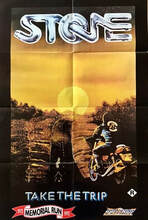
Stone 20th Memorial Run Poster 1993.
|
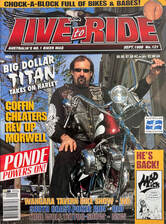
Live To Ride Magazine Volume 11 Issue 121
Number 9th September 1998. |
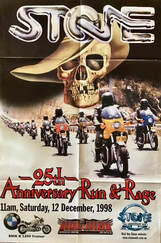
Stone 25th Anniversary Run and Rage Poster 1998.
|
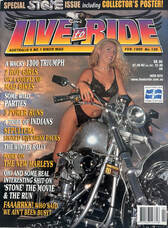
Live To Ride Magazine Volume 12 Issue 126 Number 2nd February 1999.
|
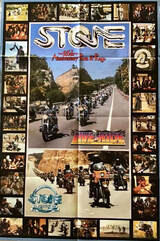
Stone 25th Anniversary Run and Rage Collectors Poster 1999.
|

Live To Ride Magazine Issue 402
May 2021. |
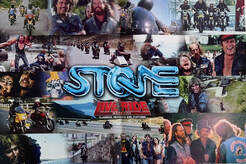
In Memory Sandy 'Undertaker' Harbutt.
Exclusive Stone Poster 2021. |
Stone 30th Anniversary Run Patch 2004.
On Saturday 20th November 2004 the Ulysses Motorcycle Club and Vietnam Veterans Motorcycle Club rode down Darling Street, Balmain, Sydney, to celebrate the 30th Anniversary of the release of the movie Stone. The film was screened as part of the Balmain Film Festival 10 Day Program, celebrating the suburbs role in Australian Film Production.
Vietnam Veterans Memorial Run Patch 2008.
On Friday 15th August 2003, the Vietnam Veterans Gippsland Chapter was accepted by all VVMC Chapters. On Saturday 21st February 2004 the Gippsland Chapter was ratified. In 2006 the Gippsland Chapter sought an alternative clubhouse... an old disused and dilapidated hall in Longwarry North, Melbourne. On Wednesday 30th August 2006 the Gippsland Chapter was granted a permit to licence and use the premises. A Stone Memorial Run Patch was commissioned for the Official Stone Run to commemorate the opening of the Longwarry North clubhouse. This event was supported by Sandy Harbutt 'Undertaker' and John Ivkovitch 'Zonk'.
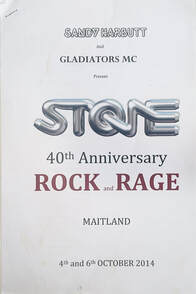
Stone 40th Anniversary 'Rock and Rage' with the Gladiators MC, 4th-6th October 2014.
Authorities withdrew the venues liquor permit, resulting in the last minute cancellation of the scheduled event.
Authorities withdrew the venues liquor permit, resulting in the last minute cancellation of the scheduled event.
The Astor Theatre in Melbourne hosted a 45th anniversary screening of the film Stone on the 28th November 2019, featuring a special presentation from Sandy Harbutt's personal 35mm print. On completion of the filming, the 35mm print was submitted to the Victorian State Library for archiving. During the evening Sandy was not feeling well, so John 'Zonk', spoke to the audience and led the meet and greet after the showing.
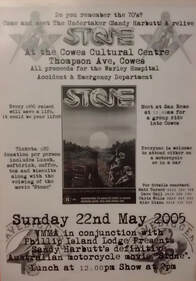
Stone Screening Sunday 22nd May 2005 at Cowes Cultural Centre. Fundraiser for Warley Hospital Accident and Emergency Department. Event included a group ride, stop for lunch and 1400 screening of Stone. Masonic Motorcycle Association, Warley Hospital Cowes and the Victorian Z Riders Owners Clubs staged what was known at the 'STONE 33 Run'... approximately 500 bikes attended to support event.

Gerringong Pics and Flicks.
A long time resident of the New South Wales South Coast, Sandy Harbutt was featured ahead of a special screening of Stone, hosted by Gerringong Pics and Flicks at the Gerringong Town Hall on Friday 07th February 2020. Tickets were $10, doors opened at 7:20 PM and the film began at 8:00 PM. Sandy Harbutt attended as a guest speaker to do a Q&A session following the screening.
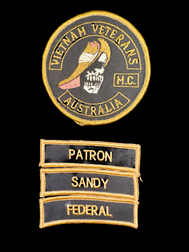
Sandy Harbutt 'Patron Of The Vietnam Veterans Motorcycle Club'.
Sandy Harbutt passed away at Wollongong Hospital at the age of 79. John 'Zonk' Ifkovitch stated online that 'My life long friend Sandy Harbutt, the Undertaker, passed away peacefully last night at Wollongong Hospital'. Sandy's relatives and friends were invited to attend Sandy’s funeral service at Parsons Funeral Home, Bulli on Saturday 05th December 2020 at 2pm. In attendance at the memorial was his ex wife Helen, his long term partner Elizabeth, Ken 'Stone' Shorter, John 'Zonk' Ifkovitch, Margaret 'Jay' Ure, 'Loaf' from Live to Ride Magazine, family, friends and members of the Veterans Motorcycle Club and Bikers Australia. Days before the funeral was to take place at the Pinegrove Memorial Park Cemetery, Minchinbury, the service was cancelled on the grounds that the procession would be lead by motorcycles. The service was rescheduled at the Parsons Funeral Home in Wollongong when the funeral directors co-ordinating the memorial provided there Chapel as the alternative. Kenn Duke from the God Squad was the celebrant, with words spoken by Helen, Liz and John. Over 150 bikes attended the funeral, with Sandy's coffin placed onto a motorcycle hearse supplied by King of the Road. Sandy's last ride snaked through Wollongong to Stanwell Tops and along the coast road into Bulli. Leading the procession were the road captains, followed by Sandy's hearse, Zonk, Zonk's son, members of Sandy's family, Veterans MC, God Squad MC, with others following behind.
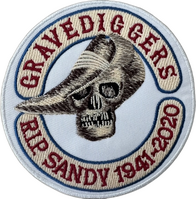
Sandy Harbutt Memorial Patch, 1941 - 2020.
Initially presented to those who attended the scattering of the 'Undertakers' ashes.
Initially presented to those who attended the scattering of the 'Undertakers' ashes.
A memorial screening of Stone was held Saturday 19th March 2021 at Westview Drive In, Dubbo; however, due to COVID restrictions the sale of tickets for the event were strictly limited. The 'Stone Rally' commenced on Friday evening with a showing of the documentary Stone Forever, with 400 enthusiastic attendees in the audience. The next day 'Zonk led a group of Memorial Run bikers back to the drive-in and out to Ballimore’s 'Hair of the Dog Inn'. The pack rumbled up the hill west out of Dubbo to Westview Drive and into the drive-in for the Saturday evening showing of Stone. At 6pm the ode and last post were played followed by a minute silence to remember those who had served... as the Grave Diggers were returned servicemen.
Brisbane Gallery Of Modern Art - The Motorcycle: Design, Art, Desire - Queensland Art Gallery's Australian Cinémathèque.
Saturday 28 November 2020 - Monday 26 April 2021.
Saturday 28 November 2020 - Monday 26 April 2021.
The Motorcycle: Design, Art, Desire opened the throttle on the ground breaking designs that shaped one of the most iconic objects the world has ever seen. The world exclusive exhibition, only in Brisbane, showcased the art, design and history of one of the most iconic objects of the last 150 years, the motorcycle. Featuring radical concepts, record breakers and road icons, the fully immersive exhibition showcased 100 innovative and influential motorcycles from the 1860s to present day.
It considered the vehicle from the perspective of social history, popular culture, design and technology. The exhibition tapped into the appeal of this enduring object of design and art, looking at the motorcycle’s past, present and future. Highlights included:
The Queensland Art Gallery's Australian Cinémathèque curated a free, 50 plus title showcase titled "Motorcycles on Screen" that ran for the entire duration of the exhibition. Stone was specifically selected as a quintessential representation of international biker culture, showcasing the distinct Ozploitation sub-genre. Beyond the full screenings in the cinema, excerpts of Stone and its iconic Kawasaki Z900 sequences were played on loops inside the exhibition spaces to set the atmospheric tone for the historical bikes. Stone shared the billing alongside other iconic Australian films like Mad Max (1979) and Shame (1988), as well as Hollywood staples like Easy Rider (1969) and The Wild One (1953).
It considered the vehicle from the perspective of social history, popular culture, design and technology. The exhibition tapped into the appeal of this enduring object of design and art, looking at the motorcycle’s past, present and future. Highlights included:
- An 1871 Perreaux, the first steam powered velocipede and oldest known motorcycle in the world
- The earliest Australian designed and built machines, including a Spencer produced in Brisbane in 1906
- The 1951 Vincent Black Lightning that set an Australian land speed record in its day and more recently a world record for the highest price paid at auction for a motorcycle
- Symbols of speed including the1930s Triumph Speed Twin, the 1970s Ducati 750 Super Sport, and the 1990s Britten V1000
- Off road motorcycles highlighting a rich history of bikes built for dust and dirt
- Customised motorcycles at the intersection of art and design
- Ultra-modern electric motorcycles, demonstrating the future of transportation in the age of renewable energy.
The Queensland Art Gallery's Australian Cinémathèque curated a free, 50 plus title showcase titled "Motorcycles on Screen" that ran for the entire duration of the exhibition. Stone was specifically selected as a quintessential representation of international biker culture, showcasing the distinct Ozploitation sub-genre. Beyond the full screenings in the cinema, excerpts of Stone and its iconic Kawasaki Z900 sequences were played on loops inside the exhibition spaces to set the atmospheric tone for the historical bikes. Stone shared the billing alongside other iconic Australian films like Mad Max (1979) and Shame (1988), as well as Hollywood staples like Easy Rider (1969) and The Wild One (1953).

Stone Ride and Rage Run Dubbo Westview Drive In Patch 2022.
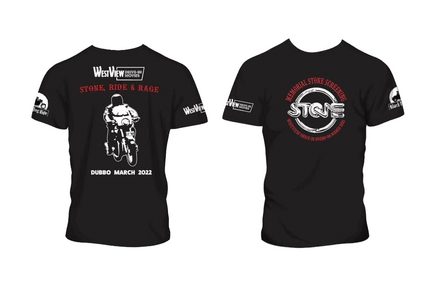
Stone Ride and Rage Run Dubbo Westview Drive-In, 2022. It was a weekend of motorcycles, music and movies; the perfect way to celebrate the Australian biker movie Stone. The 2022 Ride and Rage Stone Run was led by 'Zonk'... Marg, Zonk and Elizabeth spoke to the audience about the up and coming 50th Anniversary of Stone and the planning for the event... following the movie, live music was provided by Greenriver.
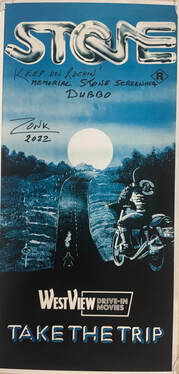
Stone Ride and Rage Run Dubbo Westview Drive-In Promotion Poster.
'Keep on Rocking Memorial Stone Screening Dubbo' Zonk 2022.
'Keep on Rocking Memorial Stone Screening Dubbo' Zonk 2022.
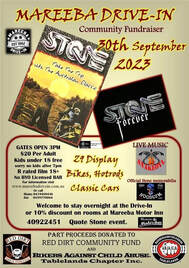
Stone and Stone Forever Screening Community Fund Raiser Mareeba Drive In Saturday 30th September 2023.
The events included live music, a display of bikes, hotrods, classic cars and Stone memorabilia.
The events included live music, a display of bikes, hotrods, classic cars and Stone memorabilia.
Stone 50th Anniversary Celebration Patch 2023.
|
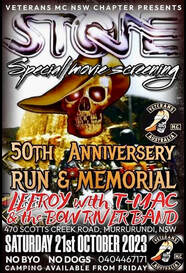
A 50th Anniversary and Memorial Run was held at FSB Pearlbrook on Saturday 21st October 2023. A special screening was shown with the Memorial Run leaving FSB Pearlbrook and returning to the clubhouse for live music.
|
Stone 50th Anniversary Celebration Veterans Motorcycle Club FSB Pearlbrook Patch 2023.
|
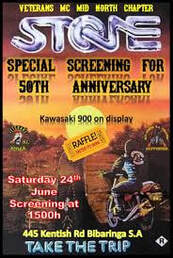
Veterans Motorcycle Club Stone 50th Anniversary Screening 24th June 2024.
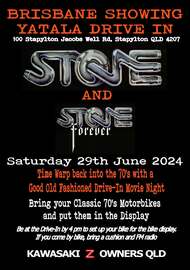
On Saturday 29th June 2024 an official showing of Stone was screened at the Cinema Paradiso in Ettalong, NSW to commemorate the 50th Anniversary and in Brisbane a double showing was screened at Yatala Drive In at 6pm.
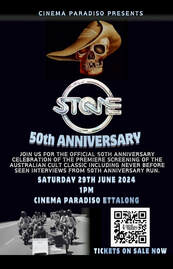
Stone 50th Anniversary Screening. Saturday 29th June 2024 Cinema Paradiso Ettalong.

Elsie's Pop Up Cinema Lounge and Bar operated in the Civic Square Canberra from February - July 2025, providing a social cinema experience in a cosy lounge setting, screening retro favourites, arthouse and international films. Stone was screened Monday 11th May 2025.
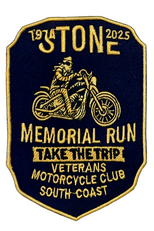
Stone Memorial Run and Opening of Veterans South Coast Motorcycle Clubhouse Patch 2025.
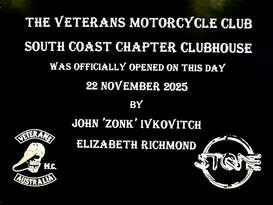
On Saturday 22nd November 2025, the Veterans Motorcycle Club South Coast was officially opened by John 'Zonk' Ivkovitch and Elizabeth Richmond. The event was proudly supported by VV & VMC Chapters, God Squad, Military Brotherhood, members and guests. Due to inclement weather, the Stone Memorial Run was shortened; thus, made its way to the Shoalhaven Heads Hotel for lunch before returning to the clubhouse to watch the movie Stone.

The showing of Stone at the Art Gallery of New South Wales was a special tribute to the film’s unique connection to the gallery’s physical site. In a famous sequence, 'Toad' hallucinates while staring at the bronze sculptures outside the gallery, making the venue itself a "character" in the movie. The event featured a restored digital version of the film and included an introductory talk exploring its status as a cornerstone of Ozploitation cinema. This screening was part of a broader program celebrating Australian film history and the counter culture movement of the 1970s. Screened Sunday 15th March 2026.
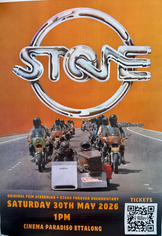
This poster advertises a screening of Stone along with the documentary Stone Forever, on Saturday 30th May 2026 at Cinema Paradiso in Ettalong Beach, New South Wales.
|
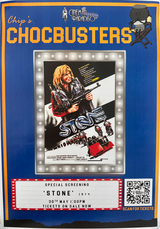
'Chip the Choctop invites you to join us at Cinema Paradiso for screenings of cinema classics on the last Friday of every month. Come and experience beloved films return to the big screen with a crowd of film lovers. Each ticket comes with a complementary choctop or small popcorn'.
|
Established in 1999 as a European inspired sanctuary for film lovers, Cinema Paradiso Ettalong Beach has built its history on celebrating both international arthouse masterpieces and gritty, homegrown cult cinema. The phenomenon of motorcycle enthusiasts converging on Cinema Paradiso Ettalong Beach transformed a quiet coastal village into an absolute sea of chrome, leather and roaring engines... riders, original movie extras and Ozploitation fans cram into Cinema Paradiso's ornate, mediterranean themed auditoriums, to celebrate a raw piece of Australian cinematic history, where the thundering roar of vintage Kawasakis on screen perfectly mirrors the passion of the massive biker community gathered outside. Drawing thousands of riders from every corner of Australia, these gatherings have created one of the most visually spectacular independent cinema events in the country. Peninsula News 2024.
'Bikers are permitted to line up and park their machines directly outside the cinema along ocean view road and schnapper road, transforming the public streets into an open air exhibition'.